
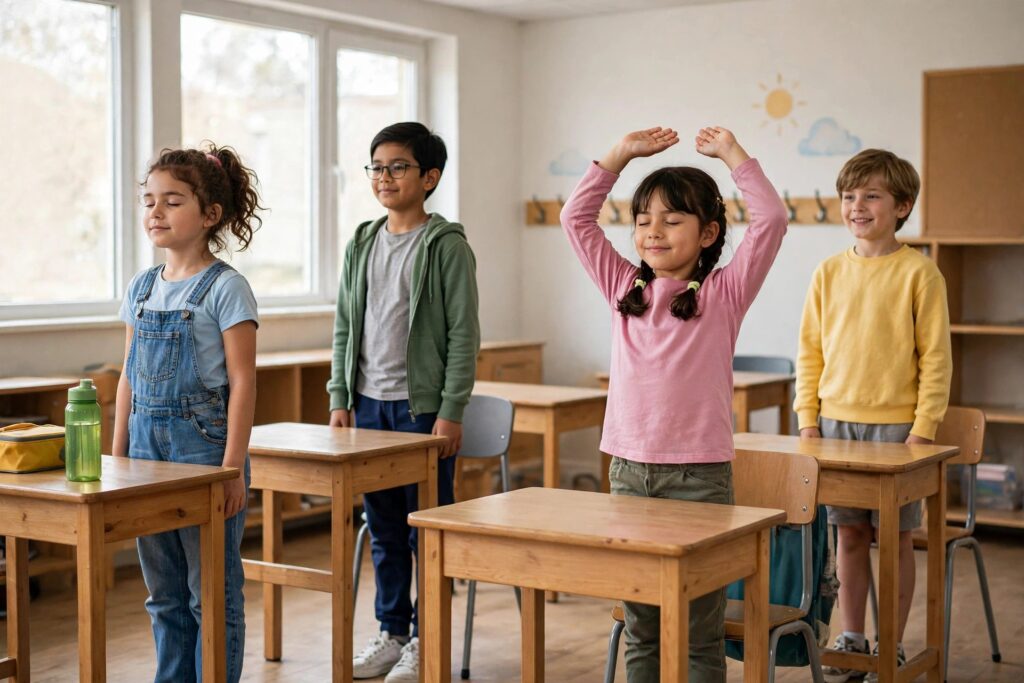
You know the moment. It is 1:15 p.m., the class just came back from lunch, and twenty-five students are staring at you like you are speaking through a fog. Nobody is being defiant. Their brains are simply done. This is not a discipline problem. It is a physiology problem, and a two-minute brain break fixes it faster than any lecture.
Classroom yoga is not a full yoga class squeezed between math and reading. It is a set of short, gentle movements and breaths that reset students’ attention and release physical tension. Each break below takes one to three minutes, needs no equipment, and works in the space between desks. Use them at transitions, before tests, and after lunch, and you will spend far less of your day fighting for attention.
If you are building a calmer classroom overall, these breaks pair well with the routines in The Complete Guide to Classroom Management.
In this guide6 sections
Why Brain Breaks Work
Movement changes the brain’s state, and state drives attention. When students sit still for forty minutes, blood flow slows, posture collapses, and the brain’s alerting system idles. A short bout of movement reverses all three: it increases blood flow to the brain, wakes up the balance system, and signals that something new is happening.
The research term for this is a state break. After one, students return with a fresher working memory, which is why a two-minute stretch before a test beats two more minutes of cramming. The breaks also teach self-regulation: a student who learns that a few deep breaths can calm their own body gains a tool they can use without you.
None of this requires athleticism or flexibility. It requires a routine students recognize, movements every body can do, and a teacher who treats the break as part of the lesson rather than a reward for finishing it.
When to Use Them
Timing matters more than the moves. A break at the right moment prevents problems; at the wrong moment it just interrupts a good flow.
At transitions. The five minutes between subjects are where classrooms lose the most time and generate the most misbehavior. A one-minute stretch between activities resets the room faster than any verbal redirect. If transitions are your problem, pair these breaks with the techniques in 25 Classroom Management Strategies That Work.
Before tests and quizzes. Test anxiety is physical: shallow breathing, tight shoulders, racing thoughts. Two minutes of slow breathing and gentle movement before you hand out a test lowers that arousal and gives students access to what they actually studied. Never skip this one.
After lunch and recess. The post-lunch slump is real and biological. Digestion pulls blood away from the brain, and recess emotions are still running. A standing stretch and one breathing exercise clears both. Give students ninety seconds to move, then start teaching. You will get the time back in attention.
During long blocks. If you teach a ninety-minute block, break it in the middle. Attention dips around the forty-minute mark, and a two-minute break at minute forty-five is the reason minutes forty-five to ninety work at all.
When you see the signs. Yawning, fidgeting, staring out the window, and a sudden rise in chatter are not defiance. They are the brain asking for a reset. When you see three of those signs at once, stop and break. Respond to the need early instead of the behavior late — our guide on classroom management techniques for new teachers explains how to build that habit in your first ninety days.
Safety Rules First
Read these rules to your students before the first break, and repeat them whenever a new move appears. Safety is what makes the breaks inclusive and sustainable.
– Gentle movements only. Every move here is low-intensity. No jumping, no balancing without support, no forcing a stretch to go further. – Stay beside your desk. Nobody travels around the room during a break. – Stop if anything hurts or causes dizziness. Pain and dizziness are stop signals, not things to push through. Any student who feels either should sit down, breathe normally, and rejoin when ready. – Participation is always optional. A student may sit out any move without explanation. Offer a seated version of every standing move, and a breathing-only option for any student who prefers it. – No inversions. Nothing here puts the head below the heart. No headstands, no shoulder stands, no hanging upside down. – Inclusive for all bodies. Every move works seated or standing, in any clothing, and at any flexibility level. Never single out a student for doing a move differently.
Use a visible timer for every break so students know exactly when it ends. A classroom timer on the board removes the “when is this over” anxiety and keeps the break to two minutes.
The 12 Brain Breaks
Teach one new break per day for the first two weeks. Once students know all twelve, let them vote for the day’s break or assign a student leader to run it. Keep your voice calm and slow, and model every move yourself.
1. Balloon Breathing (1 minute)
The single best break for calming a room: before tests, after conflicts, any time the energy is too high.
– Sit tall with feet flat on the floor and hands resting on the belly. – Breathe in slowly through the nose for four counts, imagining a balloon inflating in the belly. – Breathe out slowly through the mouth for six counts, imagining the balloon deflating. – Repeat three times.
2. Mountain Pose (1 minute)
A standing reset that teaches posture and stillness.
– Stand beside the desk with feet hip-width apart and arms relaxed at the sides. – Press both feet into the floor and imagine growing tall. – Roll the shoulders back once, then let the arms hang heavy. – Take three slow breaths, feeling the feet steady on the floor.
3. Desk-Supported Tree Pose (1 minute per side)
Balance without the wobble risk, because one hand stays on the desk.
– Stand beside the desk with one hand resting lightly on it. – Shift weight to one foot, then place the other foot against the inside of the standing ankle or calf. Never against the knee. – Bring the free hand to the heart or keep it on the desk. – Hold for five slow breaths, then switch sides.
4. Seated Cat-Cow (1 minute)
The best break for backs that have been in chairs too long. It loosens the whole spine.
– Sit near the front of the chair with feet flat and hands on the knees. – Breathe in: gently arch the back, lift the chest, and look slightly up. This is cow. – Breathe out: round the back, tuck the chin, and let the shoulders roll forward. This is cat. – Flow between cat and cow for six slow breaths.
5. Neck Rolls (1 minute)
Releases the tension students carry from looking down at screens and papers.
– Sit or stand tall. Drop the chin gently toward the chest. – Slowly roll the right ear toward the right shoulder, then the head back just slightly, then the left ear toward the left shoulder. – Make three slow circles in one direction, then three in the other. – Keep the movement small and slow. If anything pinches, skip that direction.
6. Shoulder Shrugs (1 minute)
A tension release that looks small and feels enormous.
– Sit or stand with arms relaxed at the sides. – Breathe in and lift both shoulders up toward the ears, squeezing tight for three counts. – Breathe out and drop the shoulders down hard, like shrugging off a heavy backpack. – Repeat four times.
7. Star Stretch (1 minute)
An energizing full-body stretch for low-energy moments, like the post-lunch slump.
– Stand beside the desk with feet wide apart. – Breathe in and stretch both arms up and out wide, like a star, fingers spread. – Breathe out and reach a little further, stretching tall through the fingertips. – Hold for three breaths, then lower the arms.
8. Chair Twist (1 minute per side)
A gentle seated twist that wakes up the torso.
– Sit tall near the front of the chair with feet flat. – Breathe in and sit up tall. Breathe out and twist gently to the right, placing the left hand on the right knee. – Keep both hips facing forward and the twist gentle. – Hold for four breaths, return to center, then twist to the left.
9. Shake-Out (1 minute)
The silliest-looking break and one of the most effective. It discharges restless energy fast.
– Stand beside the desk. Shake the right hand for five counts, then the left hand for five counts. – Shake the right foot for five counts, then the left foot for five counts. – Shake all four limbs together for ten counts, then freeze completely still for three breaths. – The freeze is the point: it teaches the body to go from active to calm on command.
10. Rainbow Stretch (1 minute)
A side stretch that opens the ribs. Students love the imagery.
– Stand beside the desk with feet hip-width apart. – Breathe in and sweep both arms up overhead, fingertips together like a rainbow. – Breathe out and lean gently to the right, keeping both feet on the floor. – Breathe in to center, breathe out and lean gently to the left. Repeat twice per side.
11. Eagle Arms, Seated (1 minute)
A shoulder and upper-back release that works entirely in a chair.
– Sit tall. Stretch both arms straight forward, then cross the right arm over the left. – Bend the elbows and try to bring the palms together, or rest one hand on the opposite shoulder. Either version is correct. – Lift the elbows slightly and hold for four slow breaths. – Unwind, then repeat with the left arm on top.
12. Lion Breath (1 minute)
A playful exhale that releases jaw tension and always gets a laugh.
– Sit tall. Breathe in deeply through the nose. – Breathe out through the mouth with a strong “haaa,” opening the mouth wide, sticking the tongue out, and widening the eyes like a lion. – Repeat three times, then breathe normally and smile. – Use this one when the room needs to laugh at itself before refocusing.
Building a Daily Routine
Random breaks help. A routine transforms the room. Build one with three anchors and it will run itself within two weeks.
Morning anchor. Start the day with one energizing break after morning routines: Star Stretch or Shake-Out. It signals that bodies wake up before brains are asked to work.
Midday anchor. After lunch, run one calming break before the first lesson: Balloon Breathing or Seated Cat-Cow. Same break, same time, every day. Students will start settling before you even ask.
Transition anchor. Pick one break as your standard transition reset and use it between every subject for a week: Mountain Pose or Chair Twist. When the break itself becomes the transition procedure, transitions stop costing you minutes.
Rotate the remaining breaks in as the week goes on. Post the list of twelve where students can see it, and let a different student choose the break each day. Keep every break on a classroom timer so the routine stays tight, and if you want a low-prep way to fill the last five minutes of a Friday, a round of free classroom games after the final break is a combination students will beg you to repeat.
Frequently Asked Questions
How long should a brain break be? One to three minutes. Shorter than a minute rarely resets anything, and longer than three turns a break into an activity. Two minutes is the sweet spot for most classrooms. Use a timer so the break ends when you said it would — that is what builds students’ trust in the routine.
Do I need yoga experience to lead these? No. Every break here was chosen because a teacher with zero yoga background can lead it safely. Model the move, read the steps aloud the first few times, and let students follow. Your calm voice matters more than perfect form.
What if students think it is silly? Some will, at first — especially older students. Start with the least performative breaks: Balloon Breathing, Shoulder Shrugs, Seated Cat-Cow. Let the skeptics sit out without comment and let the results do the persuading. When the class visibly settles faster after a break, the holdouts usually join within a week. Lion Breath can wait until the routine is trusted.
Is it OK for all ages? Yes, with age-appropriate framing. Younger students love the animal names and imagery. Older students respond better to honest framing: this is a focus tool athletes and performers use, not a kids’ game. The movements are gentle and safe for kindergarten through high school, and every one works seated, standing, and at any flexibility level.
Can brain breaks replace recess or PE? No. Brain breaks are resets, not exercise. They restore attention but do not replace the physical activity, social time, and free play of recess and PE. Think of them as the bridge between sitting and learning, not a substitute for moving.
What if a student refuses every break? Let them. Participation is always optional, and forcing it destroys the calm the breaks are meant to create. A student who sits quietly and breathes while the class stretches still gets most of the benefit. Check in privately later if the refusal looks like discomfort rather than preference — sometimes a move hurts, and a seated alternative solves it.