A chatty class is not a bad class. Social, talkative students often bring energy and ideas to discussions. The problem is talk at the wrong time: during instructions, independent work or when a classmate is speaking. Knowing how to handle a chatty class means channeling that energy instead of fighting it all period.
Below are 15 strategies that work in middle and high school, organized from prevention to in-the-moment responses, plus a simple two-week plan.
In this guide7 sections
First, find the pattern
Spend two or three days noticing when talking happens. Common patterns:
- At the start of class before work begins
- During long instructions or lectures
- During transitions between activities
- Among a few specific groups of friends
- When the task is too easy, too hard or unclear
The fix depends on the pattern, so start here.
Prevention strategies
- Start with a task, not a lecture. A posted warm-up gives students something to do the moment they sit down. See our bell ringer ideas.
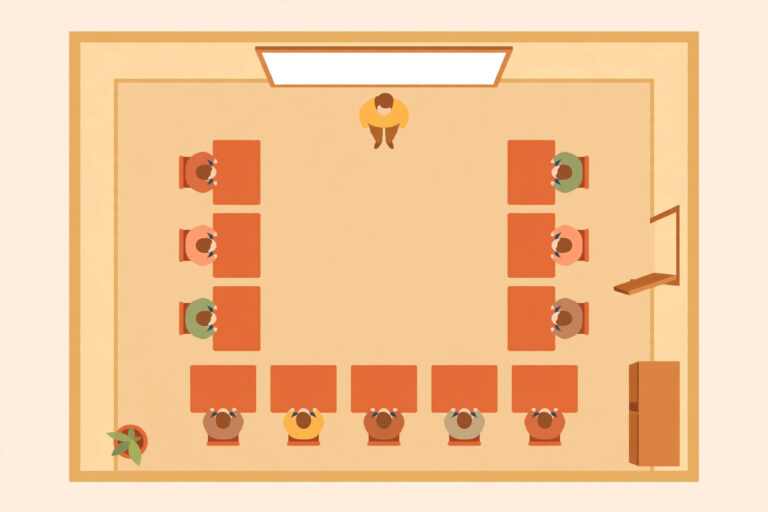
- Change the seating. Separate the most talkative pairs and create pods that mix talkers with focused students. Our classroom seating arrangements show options.
- Shorten instructions. Give one step at a time and post it on the board.
- Build in talk time. Planned partner talk every 5–10 minutes reduces unplanned talk. Our guide to think-pair-share shows how.
- Use a voice level chart. 0 = silent, 1 = whisper, 2 = table talk, 3 = presenting. Post the level for every activity.
- Clear transitions. Use a timer and a countdown for every change of activity.
In-the-moment strategies
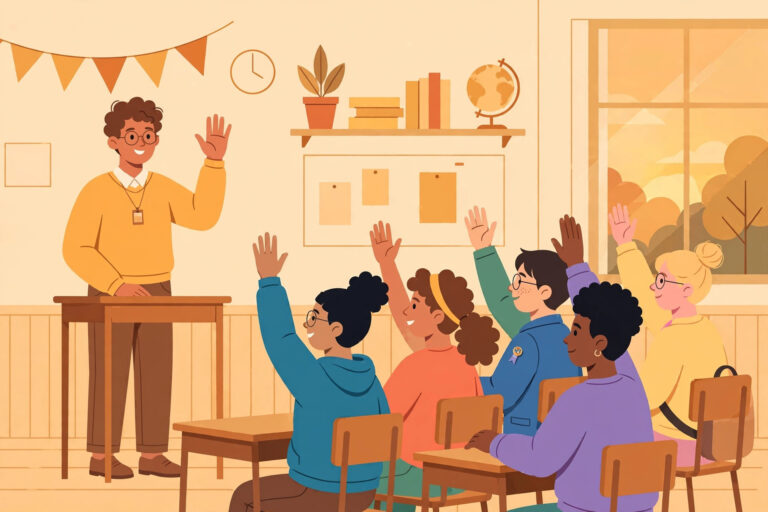
- Use a consistent attention signal and wait for full silence before speaking. See our list of classroom commands.
- Proximity. Walk toward the talking group while continuing to teach.
- The pause. Stop mid-sentence and wait. Most groups notice within seconds.
- Quiet, private reminders. A short word at the desk works better than calling students out.
- Name the positive. “Thank you, table 2, for being ready.” Others usually follow.
- Redirect with a question. Ask a chatty student a content question to bring them back.
Longer-term strategies
- Class meeting. Discuss the problem openly and let students suggest solutions.
- Talk privately with ringleaders. Ask for their help rather than starting with a consequence.
- Give social students roles. Facilitator or Reporter roles use their energy well. See our guide to group work roles.
A two-week plan
| Days | Focus |
|---|---|
| Days 1–2 | Observe and note when talking happens |
| Day 3 | New seating chart and voice level chart |
| Days 3–5 | Teach and practice the attention signal and transitions |
| Week 2 | Add planned partner talk; praise specific groups |
| End of week 2 | Class meeting to review progress |
What not to do
- Talk over the class. It teaches students they don’t need to stop.
- Punish the whole class for a few students.
- Use sarcasm. It damages relationships with exactly the students you need on your side.
- Give up on discussion. Banning all talk usually makes the problem worse.
Frequently asked questions
How do I stop a class from talking too much?
Find when talking happens, start every class with a task, change seating, use a consistent attention signal and build planned talk time into lessons.
Is it okay to let students talk in class?
Yes. Planned, on-task talk helps learning. The goal is to manage when and how students talk, not to eliminate talking.
What do I do when the whole class is talking?
Use your attention signal, wait in silence, then re-teach the expectation briefly. Avoid raising your voice over the noise.
Chatty classes respond best to structure, not volume. Combine a strong start, clear voice levels and planned talk time, and you will spend less time quieting the room and more time teaching. For more ideas, see our classroom management techniques.
Need a reliable way to quiet the room first? Try one of these 20 attention getters for high school.