“This year I’m going to study more.” It is one of the most common New Year resolutions, and one of the least likely to survive past January. The problem is not motivation. It is that the goal is vague, there is no plan for when and how, and nothing makes it easier on a tired Tuesday evening.
This guide shows you how to turn a fuzzy resolution into a study routine that lasts, using a few simple tools backed by research on goals and habits.
In this guide9 sections
Why most study resolutions fail
- They are vague. “Study more” has no start time, no place and no finish line.
- They focus only on outcomes. “Get an A in chemistry” tells you where you want to end up, not what to do today.
- They are too big. Going from zero to two hours a night lasts about a week.
- They have no plan for obstacles. Practice, friends, fatigue and phones all get in the way, and the resolution was never designed for them.
Outcome goals vs process goals
You need both kinds, but process goals are the ones you can act on every day.
| Outcome goal (where you want to end up) | Process goal (what you do each week) |
|---|---|
| Raise my math grade from C to B | Do 6 practice problems on 4 school nights a week, and check every answer |
| Pass the Spanish final | 15 minutes of vocabulary self-testing every day |
| Read more books | Read 20 pages before bed on weeknights |
| Be less stressed before exams | Start reviewing each subject two weeks before every test |
A good process goal is specific (what exactly), small enough to do on a bad day, and scheduled (when and where).
Use if-then plans
Psychologist Peter Gollwitzer studied what he called implementation intentions: plans written as “If situation X happens, then I will do Y.” His research found that this simple format makes people much more likely to follow through than goals alone (American Psychologist).
Turn each process goal into an if-then plan:
- “If it is 4:30 on a school day, then I sit at my desk and do one 25-minute math session.”
- “If I get on the bus in the morning, then I review 20 Spanish flashcards.”
- “If I reach for my phone during a study session, then I put it in the other room.”
The “if” part ties the habit to a time, place or event that already exists, so you don’t have to remember to start.
Plan for obstacles with WOOP
WOOP is a goal-setting method developed by psychologist Gabriele Oettingen. It takes five minutes:
- Wish: what do you want? (“Finish homework before 8 p.m.”)
- Outcome: what is the best result? (“Free evenings, less stress, better sleep.”)
- Obstacle: what inside you usually gets in the way? (“I start scrolling after school and lose an hour.”)
- Plan: an if-then plan for that obstacle. (“If I get home, then my phone goes on the charger in the kitchen until homework is done.”)
The obstacle step matters most. Thinking only about the outcome feels good but can make you less prepared for the hard moments.
Expect it to take weeks, not days
A study by Phillippa Lally and colleagues followed people building a new daily habit, such as eating fruit at lunch or going for a run (European Journal of Social Psychology). On average it took about 66 days for the behavior to become automatic, with a huge range from 18 to 254 days depending on the person and the habit. Missing a single day did not ruin the process.
Two lessons: be patient for two or three months, and if you miss a day, just restart the next day. One missed session is not failure; quitting after one is.
Build your routine in 4 steps
- Start tiny. Begin with a version you can do even on your worst day: 10 minutes, one page, five problems. Add time once it feels automatic.
- Anchor it. Attach the study session to something you already do every day: after dinner, after practice, on the bus.
- Make it easy to start. Leave your books open on the desk, put your phone in another room and use a timer. Our classroom timer works full-screen in any browser.
- Track it. Mark each day you complete the routine. A visible streak is motivating, and it shows you patterns (for example, Thursdays always fail because of practice).
A simple habit tracker
| Habit | Mon | Tue | Wed | Thu | Fri | Sat | Sun |
|---|---|---|---|---|---|---|---|
| 25 min focused homework | |||||||
| 15 min self-testing | |||||||
| Phone out of room while studying | |||||||
| In bed by 10:30 p.m. |
Copy it into a notebook, or print this page and fill it in each evening.
A sample weekly routine
| When | What |
|---|---|
| School days, after a snack | Two 25-minute pomodoros of homework, hardest subject first |
| School days, on the bus or after dinner | 15 minutes of self-testing on recent lessons |
| Saturday | Free, or catch-up only if something was missed |
| Sunday, 20 minutes | Weekly review: mixed quiz on the week’s topics, plan next week, check the tracker |
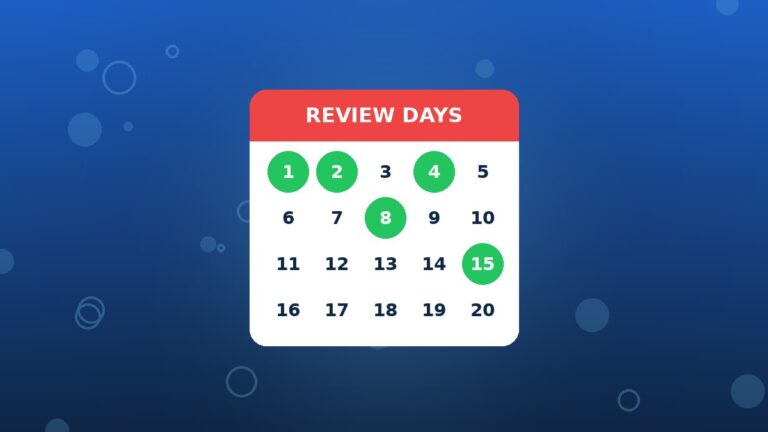
The daily self-testing follows the spaced repetition idea: review new material after a day, a few days and a week. If you want a ready-made daily habit, try our Daily Brain Challenge: three new questions every day, about two minutes.
Review your goals every week
Once a week, spend ten minutes asking three questions:
- What worked this week?
- What got in the way, and what is my if-then plan for it next week?
- Is my goal still the right size? (Too easy: add a little. Too hard: shrink it.)
Goals are not set once in January. They are adjusted every week until the routine runs on its own.
Frequently asked questions
What are good New Year study goals for high school students?
Good goals are specific process goals you can do every week, such as “15 minutes of self-testing every school day” or “start reviewing for each test two weeks early.” Pair each one with an if-then plan.
How long does it take to build a study habit?
In one well-known study, it took an average of about 66 days for a daily behavior to become automatic, with a wide range from 18 to 254 days. Expect at least two months, and don’t worry about missing a single day.
What if I fall behind on my goals?
Restart the next day and shrink the goal if needed. Look for the obstacle that caused the slip and write an if-then plan for it. Consistency over weeks matters far more than a perfect streak.