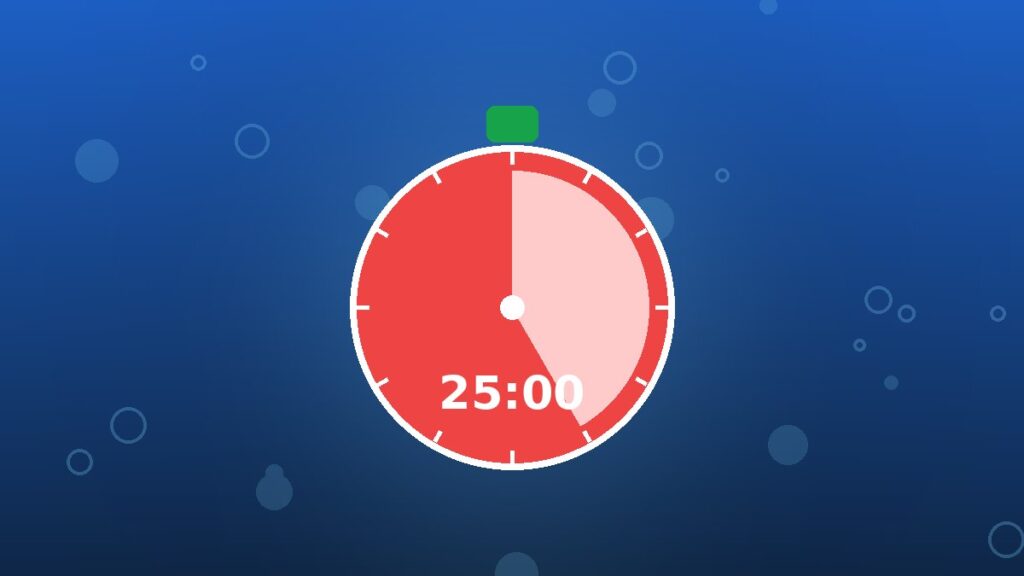
The Pomodoro Technique is a simple way to study: work on one task for 25 minutes, then take a 5-minute break. After four rounds, take a longer break of 15 to 30 minutes. That is the whole method.
Francesco Cirillo developed it in the late 1980s while he was a university student, using a kitchen timer shaped like a tomato (pomodoro in Italian). It has stayed popular because it solves the problem most students actually have. Understanding the material is rarely what stops you. Starting, and staying on task once the phone buzzes, usually is.
In this guide9 sections
Why short sprints work for studying
There is little research on the Pomodoro Technique as a named method. It does combine several habits that make studying more effective:
- It makes starting easier. “Study chemistry” feels huge. “Do 25 minutes of chemistry” is small enough to begin right now.
- It protects your attention. A sprint has one task and no phone. Constant switching between homework and messages makes each task take longer and feel harder.
- It builds in rest. Short planned breaks keep you fresh for the next block, instead of fading out after an hour.
- It makes effort visible. Counting pomodoros (“I did six today”) is more motivating than counting hours you sat at a desk.
How to do a pomodoro, step by step
- Pick one specific task. Not “biology” but “answer questions 1 to 8 on cell transport.”
- Put your phone out of reach. Another room is best. Silent mode on the desk still pulls your attention.
- Start a 25-minute timer. Any timer works. Our free classroom timer runs full-screen in a browser tab.
- Work until it rings. If you remember something unrelated (“text Sam back”), write it on a scrap of paper and return to the task.
- Take a 5-minute break. Stand up, drink water, stretch or look out of a window.
- Repeat. After the fourth pomodoro, take a longer break of 15 to 30 minutes.
Tip: Write a check mark for every pomodoro you finish. At the end of the week, you will know exactly how much focused study time each subject got.
What to do in a 25-minute sprint
A pomodoro works best when the task fits inside it. Use these as a guide:
| Subject | One pomodoro | Two pomodoros |
|---|---|---|
| Math | 6–10 practice problems, checking each answer | A full worksheet plus correcting mistakes |
| Science | Self-test on one section with flashcards | Draw and label a diagram from memory, then compare with notes |
| English | Outline one essay paragraph | Write a full first draft of a short essay |
| History | Turn one chapter section into 10 quiz questions | Build a timeline of a unit from memory |
| Languages | 30 vocabulary cards with recall, not rereading | A short writing task using new vocabulary |
Notice that most tasks ask you to produce something: answers, questions, a diagram. Rereading notes for 25 minutes feels productive but leaves less in memory than testing yourself on the same notes.
Good breaks and bad breaks
The break matters as much as the sprint. A good break rests your attention. A bad one drags you into something you cannot stop after five minutes.
Good breaks:
- Walk around the house or step outside
- Refill your water and have a small snack
- Stretch your neck, shoulders and wrists
- Look at something far away to rest your eyes
- Talk to someone in the room
Breaks that usually go wrong:
- Opening social media or a video app, because five minutes becomes thirty
- Starting a game with no natural end
- Checking messages that need long replies
If you really want your phone on a break, save it for the long break after four pomodoros, and set a timer for that too.
Adjust the timer to fit you
Twenty-five minutes is a starting point, not a rule. Adjust it based on how you work and what the task is.
| Pattern | Work / break | Best for |
|---|---|---|
| Starter | 15 / 3 | Days when starting feels impossible, or younger students |
| Classic | 25 / 5 | Most homework and review |
| Deep work | 50 / 10 | Long essays, projects, problem sets you are in the flow of |
| Exam mode | 25 / 5 × 4, then 30 | Long revision sessions before finals |
If you finish early, use the remaining minutes to review what you just did or to check your answers. If the timer rings while you are in the middle of a hard problem, finish the problem first. The method should support your focus, not interrupt it.
Common problems and how to fix them
“I keep getting interrupted.” Tell your family when your sprint starts and ends. Twenty-five minutes is a reasonable thing to ask for. If you get interrupted anyway, restart the timer instead of counting a half-pomodoro.
“My mind wanders after ten minutes.” That is normal at first. Keep a distraction list next to you and write the thought down instead of acting on it. Focus improves with practice, like a muscle.
“I don’t know what to do in the sprint.” Spend your first pomodoro of the evening planning. List every task, estimate how many pomodoros each needs, and order them.
“The break turns into an hour.” Set a timer for the break too, and decide your next task before the break starts, so you can begin immediately.
A sample homework evening
Here is how a two-hour evening looks with four pomodoros:
| Time | Block | Task |
|---|---|---|
| 6:00–6:25 | Pomodoro 1 | Math problem set, questions 1–8 |
| 6:25–6:30 | Break | Water, stretch |
| 6:30–6:55 | Pomodoro 2 | Math questions 9–15, check answers |
| 6:55–7:00 | Break | Walk around |
| 7:00–7:25 | Pomodoro 3 | Biology: self-quiz on cell transport |
| 7:25–7:30 | Break | Snack |
| 7:30–7:55 | Pomodoro 4 | English: outline essay paragraphs |
| 7:55–8:20 | Long break | Free time |
Two hours, four focused blocks, and the hardest subject done first while your energy is highest.
Using a timer in class
Teachers can use the same idea in lessons. A visible countdown on the projector helps the whole class settle into independent work, and a short planned break keeps a long period from dragging. Our classroom timer is free, full-screen and needs no login. Our guide to classroom commands has short phrases for starting and ending a timed work block.
Frequently asked questions
Is 25 minutes the best length for studying?
It is a good default, not a magic number. Many students do better with 15 minutes when starting a dreaded task, or with 45 to 50 minutes once they are focused. Use whatever length you can sustain without checking your phone.
Can I listen to music during a pomodoro?
Instrumental music at low volume works for some people, especially for routine tasks. For reading or memorizing, silence usually works better because lyrics compete with the words you are trying to process.
How many pomodoros should I do per day?
On a normal school day, four to six pomodoros of homework (about two to two and a half hours of focused work) is plenty for most high school students. Before exams you may do more, with longer breaks between sets.