Most students already know how to make flashcards: write a word on the front, a definition on the back, and flip through the stack the night before the test. The problem is that this version feels productive while doing very little. If you want to teach students how to make flashcards that actually stick, the card itself and the way it is reviewed matter far more than the color of the index card or the app they use.
This guide is written for middle and high school teachers who want to turn flashcards into real active recall practice. You will find rules for writing better cards, a step-by-step review routine, a simple Leitner box setup, sentence starters students can copy, and a quick rubric you can use to check a stack before a unit test.
In this guide10 sections
- Why most student flashcards do not work
- How to make flashcards: 7 rules for a good card
- A step-by-step flashcard review routine
- Set up a simple Leitner box in class
- Ready-to-use templates and sentence starters
- Flashcard quality rubric (quick check)
- Variations for different grade levels
- Common mistakes teachers can prevent
- Frequently asked questions
- Wrapping up
Why most student flashcards do not work
Flashcards are a retrieval tool. They help memory when a student looks at the prompt, tries to pull the answer out of their own head, and only then checks. In practice, students often sabotage that process in three ways:
- They peek. Flipping the card after one second turns retrieval into rereading. The effort of trying to remember is exactly what strengthens memory.
- They overload the card. A back side with six bullet points copied from the textbook cannot be checked honestly. The student “kind of knew it” and moves on.
- They drop cards too early. Getting a card right once in a row, five seconds after seeing it, says little about whether it will be remembered next week.
The fix is not more cards. It is better cards, reviewed with a short delay, with honest self-checking. That connects flashcards directly to spaced repetition and to the broader idea of retrieval practice that cognitive scientists have studied for decades.
How to make flashcards: 7 rules for a good card
Teach these rules explicitly. Model two or three cards on the board, then have students fix a “bad card” before they write their own.
- One idea per card. If the answer has a list, split it. “Name the three types of rock” becomes three cards, each asking how one type forms.
- Ask a question, not a topic. “Photosynthesis” is a topic. “What are the inputs and outputs of photosynthesis?” is a question a student can answer or fail.
- Write the answer in your own words. Copying the glossary gives students words they recognize but cannot produce.
- Go both directions for vocabulary. Term on front and definition on back, plus a second card with the definition on front. Producing the term is harder than recognizing it.
- Add a “why” or “example” card. For every few fact cards, write one that asks why something happens or for an example: “Give a real-life example of Newton’s third law.”
- Use pictures and diagrams. A blank map, a labeled cell with one label covered, or a graph with “what does the slope mean?” works well, especially for visual learners and English learners.
- Keep the front short. A student should read the prompt in under five seconds. Long prompts slow down review and hide the actual question.
Bad card vs. better card
Show students this comparison before they start writing.
| Subject | Weak card (front / back) | Stronger card (front / back) |
|---|---|---|
| Biology | Mitosis / long paragraph about all phases | What happens to chromosomes during anaphase? / Sister chromatids are pulled apart to opposite poles. |
| History | Causes of WWI / list of four causes | How did the alliance system turn a regional conflict into a wider war? / Answer in one or two sentences. |
| Chemistry | Ionic bond / textbook definition | Why do sodium and chlorine form an ionic bond? / Na gives up one electron, Cl gains it, opposite charges attract. |
| Spanish | perro / dog | “I walk the dog every morning” in Spanish / Paseo al perro todas las mañanas. |
| Math | Quadratic formula / formula written out | Solve x² − 5x + 6 = 0. Which method is fastest and why? / Factoring: (x − 2)(x − 3). |
A step-by-step flashcard review routine
Students need a routine as much as they need cards. Post this on the wall or in your learning management system.
- Shuffle. Never study in the same order every time; the order becomes a clue.
- Say or write the answer before flipping. Out loud, in a whisper, or on scrap paper. “I know it” in your head does not count.
- Sort honestly into three piles: got it fast, got it slowly, missed it.
- Repeat only the missed and slow piles until each card is answered correctly once.
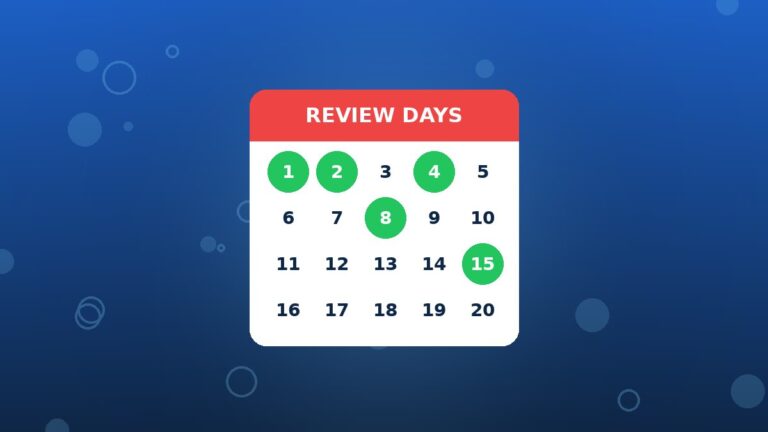
- Stop and come back later. Review again tomorrow and in a few days instead of cramming one long session.
- Mix in older cards. Add a handful of cards from previous units each session. This works like interleaving and keeps earlier material from fading.
A 10-minute session done this way usually beats an hour of flipping cards in order on the bus.
Set up a simple Leitner box in class
The Leitner system, created by German science journalist Sebastian Leitner, is a low-tech way to schedule review. All you need is an envelope, a shoebox, or a few rubber bands.
- Box 1: new cards and any card you miss. Review every study session.
- Box 2: cards answered correctly once. Review every other session.
- Box 3: cards answered correctly twice in a row. Review about once a week.
- Box 4 (optional): “mastered” cards. Review before the unit test and the final.
The rule is simple: a correct answer moves the card up one box; a miss sends it all the way back to Box 1. Students quickly see which ideas they really know. In class, try a five-minute “Box 1 sprint” as a bell ringer twice a week.
Paper or app?
Both can work. Paper cards make it easier to draw diagrams and avoid phone distractions. Apps such as Anki or Quizlet can schedule spaced review automatically, which is useful for large vocabulary sets. Whatever the format, the same rules apply: students should write their own cards, answer before flipping, and grade themselves honestly. Pre-made decks from the internet skip the most useful step, which is deciding what the question should be.
Ready-to-use templates and sentence starters
Many students freeze when they try to turn notes into questions. Give them these stems on a half sheet:
- What is the difference between ___ and ___?
- Why does ___ happen?
- What would happen if ___ were removed or changed?
- Give one real-world example of ___.
- What are the steps to ___? (Then split each step into its own card.)
- Which mistake do students often make with ___?
- Label the missing part of this diagram.
Teacher script for introducing the task: “Take your notes from today. Find three things you think will be on the quiz. Turn each into a question that has one clear answer. If your answer takes more than two lines, split the card.”
Flashcard quality rubric (quick check)
Use this four-point check during a work session or as a quick formative grade. It takes about a minute per stack and pairs well with other formative assessment strategies.
| Criterion | Needs work (1) | Solid (2) | Strong (3) |
|---|---|---|---|
| Question format | Mostly topics or single words | Mix of topics and questions | Nearly every card is a clear question |
| One idea per card | Answers are long lists | Some cards overloaded | Each card checks one idea |
| Own words | Copied from text | Partly paraphrased | Written in student language |
| Depth | Only definitions | A few “why” or example cards | Regular why, example, and diagram cards |
Variations for different grade levels
Middle school
Limit new cards to five to eight per lesson and do the first round together. Partner quizzing works well: one student reads the front, the other answers, then they swap roles. Celebrate cards that move from Box 1 to Box 2.
High school
Expect students to build their own deck for each unit and keep it through the semester. Before a cumulative exam, ask them to pull 20 cards from earlier units and mix them in. Pair flashcards with the blurting method for bigger topics where connections matter more than single facts.
Students with IEPs or English learners
Allow picture-based fronts, sentence frames on the back, and pre-written question stems. For language learners, put the word in a short sentence instead of alone.
Common mistakes teachers can prevent
- Grading only completion. Twenty cards that are all definitions earn full credit, so the habit never improves. Use the rubric instead.
- Making flashcards the whole study plan. Cards are great for facts and vocabulary but weak for essays and multi-step problems. Combine them with practice problems and a study guide.
- Waiting until the night before. Have students make cards at the end of each lesson so review can be spaced across the unit.
For more background on the research behind retrieval and spacing, the free teacher guides at RetrievalPractice.org are a good starting point.
Frequently asked questions
How many flashcards should a student make per lesson?
For most classes, five to ten well-written cards per lesson is plenty. A smaller deck reviewed several times is more useful than a huge stack that never gets finished.
Are digital flashcards better than paper ones?
Neither is automatically better. Digital apps can schedule review for you, while paper cards make drawing easier and remove phone distractions. The habits of answering before flipping and self-grading honestly matter more than the format.
Should students use pre-made flashcard decks?
Pre-made decks can help for standard vocabulary, but students learn more by deciding what to ask and writing answers in their own words. If they use a shared deck, ask them to edit or rewrite at least some of the cards.
How often should students review their flashcards?
Short, spaced sessions work best: a quick review the same day, again the next day, then a few days later, and before the test. A Leitner box makes this schedule easy to follow without an app.
Wrapping up
Learning how to make flashcards well is a small skill with a big payoff. When students write one clear question per card, answer before they flip, and come back to the stack over several days, flashcards become real practice instead of passive review. Start with the seven rules, model a few cards, and give students the Leitner box routine. Within a unit, you should see better questions, more honest self-checking, and fewer “I studied but forgot everything” moments.