Why does Earth go around the Sun instead of falling into it? Students often know the word “gravity” but struggle to explain how a pull toward the Sun produces a path around it. PhET’s free Gravity and Orbits simulation makes that idea visible in minutes.
Students switch gravity on and off, change the masses of the Sun and Earth, and drag velocity arrows to launch planets into new orbits. This guide turns the simulation into a 50-minute lesson for grades 8–12, with discussion questions and a free printable worksheet with a teacher answer key.
Free worksheet: 15 questions in five parts, prediction tables and a full answer key. US Letter.
In this guide7 sections
Lab at a glance
| Grade level | 8–12 (physical science, physics, Earth and space science) |
| Time | 45–60 minutes |
| Simulation | Gravity and Orbits: Model and To Scale screens |
| Big ideas | Newton’s first and third laws, gravitational force, circular motion, orbital speed |
| Students will | Explain why orbits happen, predict how mass and speed change an orbit, compare orbital periods |
| Where to open it | Our science simulations page or the PhET website |
Know the simulation in 3 minutes
The Model screen has four scenes in its top-right panel: the Sun and Earth; the Sun, Earth and Moon; Earth and the Moon; and Earth with a satellite. Below the scenes are:
- a Gravity on/off switch
- checkboxes for Gravity Force (blue arrows), Velocity (green arrows), Path and Grid
- sliders for the star and planet masses, from 0.5 to 2 times the real values
- a timer that counts Earth days (or Earth minutes for the satellite)
The To Scale screen shows the same systems with realistic sizes, which is a lesson in itself: the planets become tiny dots.
Two tips before class: press the round reset arrow next to a scene to restore it after each experiment, and pause the simulation before dragging a velocity arrow.
Step-by-step lesson plan
Part A: What keeps Earth in orbit? (15 minutes)
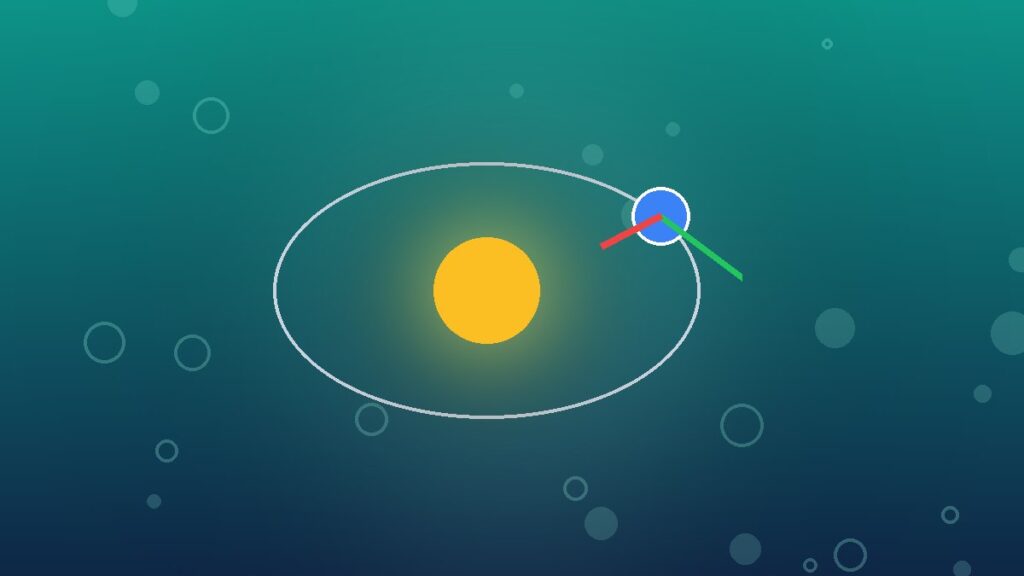
Students run the Sun-Earth scene with force and velocity arrows on. They notice three things:
- The force on Earth always points at the Sun, while the velocity points sideways. In a circular orbit they are at right angles.
- The force arrows on the Sun and on Earth are the same size. The Sun pulls Earth exactly as hard as Earth pulls the Sun: Newton’s third law. This surprises almost every class.
- When gravity is switched off, Earth flies off in a straight line. It does not fly “outward”; it continues in the direction it was moving at that moment. That is Newton’s first law.
Put the three together and students can explain an orbit: Earth is always falling toward the Sun, but it is moving sideways fast enough that it keeps missing.
Part B: Change the masses (10 minutes)
Students predict, then test, what happens when they double or halve the star’s mass and the planet’s mass. The results are a great discussion starter:
- Star mass doubled: a stronger pull bends Earth inward into a smaller, stretched orbit.
- Star mass halved: Earth swings out into a huge orbit or escapes. At half the Sun’s mass, Earth’s normal speed is exactly the escape speed.
- Planet mass changed: the force arrows grow or shrink, but the orbit barely changes, because a heavier planet also needs more force to accelerate (a = F ÷ m).
Part C: Change the speed (10 minutes)
Pausing the simulation and dragging the tip of the velocity arrow lets students launch Earth faster or slower. Too slow and it spirals toward the Sun; faster and the orbit stretches into an ellipse; much faster and Earth escapes. On stretched orbits, students can see Earth speed up near the Sun and slow down far away, which is Kepler’s second law in action.
Part D: Compare systems (10 minutes)
Students time the orbits: about 365 days for Earth around the Sun, about 27 days for the Moon around Earth, and roughly 90 minutes for a satellite in low orbit. Ask why the satellite is so fast. It orbits much closer to Earth, where gravity is stronger, so it must move faster to keep from falling in.
Part E: Discussion (5–10 minutes)
Use the discussion questions below as a whole-class wrap-up or an exit ticket.
Discussion questions
- Newton said the Moon is always “falling” toward Earth. What did he mean?
- Why don’t astronauts on the space station float because “there is no gravity up there”? (Gravity at that height is still about 90% as strong as on the ground. They float because they and the station are falling around Earth together.)
- The Sun pulls on Earth as hard as Earth pulls on the Sun. So why does Earth do all the moving?
- If Earth suddenly doubled in mass, would the length of a year change much? Use your observations.
- Why is the first stage of a rocket launch mostly about going sideways fast, not just up?
- Gravity follows an inverse square law: double the distance and the force drops to a quarter. What would happen to a planet’s orbit if the Sun’s gravity followed a different rule?
Questions 2 and 5 are strong for advanced classes because they connect the simulation to real spaceflight.
Common misconceptions to watch for
- “There is no gravity in space.” Gravity extends far beyond Earth. The Moon and every satellite are held in orbit by it.
- “The bigger object pulls harder.” Both objects pull on each other with equal force. The smaller object moves more because it has less mass.
- “If gravity disappeared, Earth would fly straight out, away from the Sun.” It would move along a straight line in the direction it was already traveling, at a tangent to the orbit.
- “Heavier planets orbit faster.” A planet’s own mass barely affects its orbit. Distance from the star and the star’s mass are what matter.
Extensions
- Kepler’s third law: students time orbits at different distances and look for the pattern (the square of the period is proportional to the cube of the orbit’s radius).
- Satellite design: given that a satellite must orbit in 24 hours to stay above one spot on Earth, should it be closer or farther than the space station? (Much farther, about 36,000 km up.)
- Pair with energy: our Energy Skate Park lab uses the same worksheet style to teach conservation of energy, which links to why elliptical orbits speed up near the star.
Frequently asked questions
What grade level is the Gravity and Orbits simulation for?
The qualitative parts (forces, paths, turning gravity off) work from about grade 6. The full lab with mass, speed and Newton’s laws suits grades 8–12.
Does the simulation show real orbital periods?
Yes, approximately. The Earth-Sun orbit takes about 365 Earth days and the Moon about 27 days. The Model screen enlarges the bodies so you can see them, but the To Scale screen shows realistic sizes.
How can I review this lab later?
Ask three questions from memory a few days after the lab: why Earth does not fall into the Sun, what happens if gravity switches off, and why a planet’s mass barely changes its orbit. Short recall questions like these are one of the best ways to make a lab stick, as explained in our guide to active recall.