Good notes do two jobs. They record what you need to remember, and the act of writing them helps you process it. Copying every word the teacher says does the first job badly and the second not at all.
There is no single best method. The Cornell method, outlines and mind maps each fit different classes and different ways of teaching. This guide explains all three, shows the same short lesson written each way, and helps you pick the right one for each subject.
In this guide8 sections
The three methods at a glance
| Method | Best for | Strengths | Weaknesses |
|---|---|---|---|
| Cornell notes | Most classes, especially science and history | Built-in self-testing and summary | Takes setup; the cue column must be filled in after class |
| Outline | Well-organized lectures and textbooks | Fast, clear hierarchy, easy to scan | Hard to use when the lesson jumps around |
| Mind map | Brainstorming, connections, review | Shows how ideas link; visual and memorable | Messy in fast lectures; weak for step-by-step detail |
The Cornell method
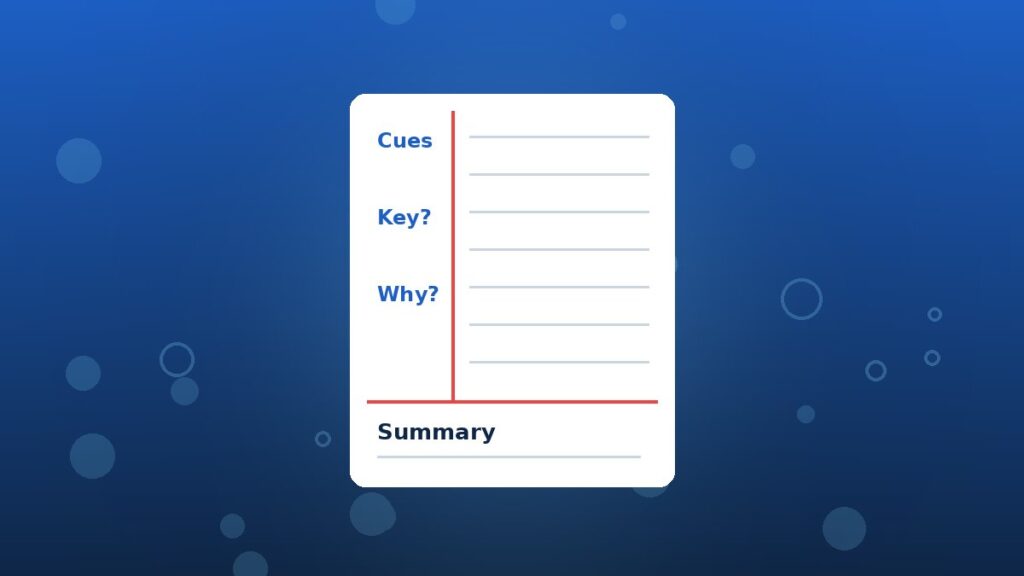
The Cornell method was developed by Walter Pauk, an education professor at Cornell University, in the 1950s. It splits each page into three areas:
- Notes column (right, about two-thirds of the page): what you write during class
- Cue column (left, about one-third): questions and keywords you add after class
- Summary (bottom few lines): two or three sentences in your own words
How to use it
- Record. During class, write the main ideas and examples in the notes column. Use short phrases, not full sentences.
- Reduce. Within 24 hours, write questions or keywords in the cue column next to each section. “Chlorophyll” becomes “What does chlorophyll do?”
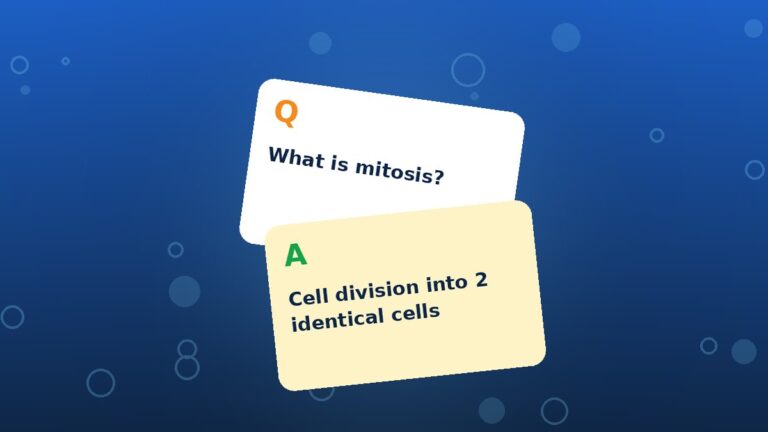
- Recite. Cover the notes column and answer each cue question out loud. This is where the learning happens.
- Reflect. Write the summary at the bottom: what is the big idea of this page?
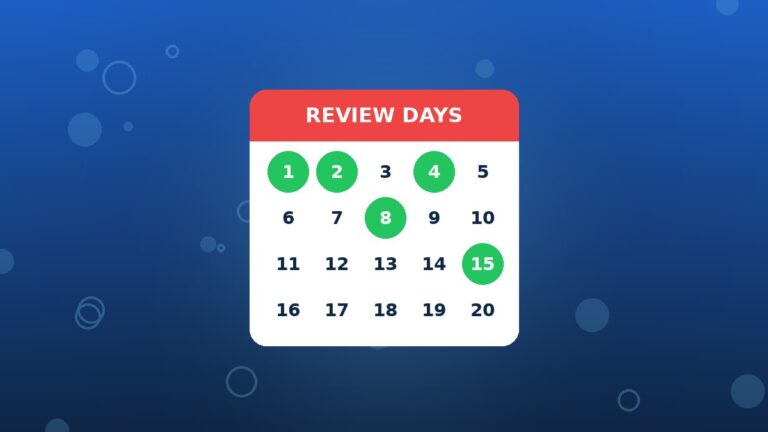
- Review. Repeat the recite step for a few minutes each week.
The power of the Cornell method is that it turns your notes into a self-quiz. That is active recall, one of the most effective ways to study.
Example: Cornell notes on photosynthesis
| Cue column | Notes column |
|---|---|
| What is photosynthesis? | Plants make glucose from CO₂ + water using light energy |
| Where does it happen? | In chloroplasts, mainly in leaf cells |
| What does chlorophyll do? | Green pigment, absorbs light (mostly red and blue) |
| What are the products? | Glucose + oxygen (O₂ released through stomata) |
| Word equation? | carbon dioxide + water → glucose + oxygen |
Summary: Plants use light energy, captured by chlorophyll in chloroplasts, to turn carbon dioxide and water into glucose, releasing oxygen.
The outline method
Outlines organize information into levels: main topics, subtopics and details, each indented further. They work best when the teacher or textbook is already well organized.
Example: an outline on photosynthesis
- Photosynthesis
- Definition: making glucose from CO₂ and water using light
- Location: chloroplasts in leaf cells
- Key parts
- Chlorophyll: absorbs red and blue light
- Stomata: let CO₂ in and O₂ out
- Equation
- carbon dioxide + water → glucose + oxygen
Tips for better outlines
- Leave space between main topics so you can add details later.
- Do not worry about perfect numbering in class. Indentation is enough.
- After class, turn each main heading into a question and test yourself.
The mind map method
A mind map puts the main topic in the center of the page, with branches for subtopics and smaller branches for details. The technique was popularized by the British author Tony Buzan in the 1970s.
Example: a mind map on photosynthesis (in words)
- Center: Photosynthesis
- Branch 1, Inputs: carbon dioxide (from air, through stomata) · water (from roots) · light energy
- Branch 2, Where: leaves → cells → chloroplasts → chlorophyll
- Branch 3, Outputs: glucose (energy store, builds cellulose) · oxygen (released)
- Branch 4, Links: respiration is the reverse process · food chains start here
Use color for each branch, keep each label to one or two words, and draw lines between branches that connect. Mind maps are excellent for reviewing a whole unit on one page or planning an essay, but they are hard to draw quickly while a teacher is talking.
Which method for which class?
| Subject or situation | Recommended method |
|---|---|
| Biology, chemistry, physics lectures | Cornell notes |
| History and social studies | Cornell or outline |
| Math | Worked examples with a “why” note beside each step |
| English literature | Cornell, with quotes in the notes column and themes in the cue column |
| Reading a textbook chapter | Outline |
| Reviewing a whole unit before a test | Mind map |
| Planning an essay or project | Mind map |
You can also combine them: take Cornell notes in class, then turn a whole unit into a mind map before the exam.
Laptop or paper?
A widely cited 2014 study by Mueller and Oppenheimer found that students who took notes on laptops tended to copy lectures word for word and did worse on conceptual questions than students who wrote by hand (Psychological Science). A careful replication in 2019 found the differences were smaller and less consistent than the original suggested (Educational Psychology Review).
The practical lesson holds either way: notes help when you put ideas in your own words, and hurt when you transcribe. If you type, resist copying everything. If you write, use abbreviations so you can keep up. And on a laptop, close every tab except your notes.
7 habits that make any notes better
- Write the date and topic at the top of every page.
- Use abbreviations you will understand later: w/ (with), b/c (because), → (leads to), ↑ (increase).
- Mark what confuses you with a “?” in the margin and ask about it before the next class.
- Leave white space. Crowded notes are hard to review and impossible to add to.
- Copy examples, not just definitions. Examples are what make definitions make sense.
- Review within 24 hours. Even five minutes the same evening helps you remember far more.
- Turn notes into questions. Then test yourself on a schedule. Our guide to spaced repetition shows a simple weekly plan.
Frequently asked questions
What is the best note-taking method for high school?
The Cornell method is the best all-round choice, because it includes a self-test and a summary. Outlines work well for organized lectures, and mind maps are best for review and planning.
Should I rewrite my notes neatly after class?
Only if rewriting means processing: adding questions, summaries or connections. Simply copying notes more neatly takes time and adds little. Spend that time testing yourself instead.
How do I keep up when the teacher talks fast?
Write key words instead of sentences, use abbreviations and leave gaps to fill in after class. If you are allowed, compare notes with a classmate the same day to fill in what you missed.