The weeks after winter break are a second first day of school. Students come back with new habits, routines have faded, and the patience you had in September has been spent. A mid-year classroom management reset lets you fix what slipped without starting over or punishing the whole class.
This guide gives you a 12-step plan you can run in the first two weeks of January (or any time things feel off). It works for grades 6–12 and takes about 20 minutes of class time per day during the first week.
In this guide7 sections
Why a mid-year reset works
By December, most classroom problems are not new problems. They are small habits that grew: phones out a little longer, a slower start to class, side talk during instructions. A break interrupts those habits. When students return, they expect something to be different, which makes January the easiest time all year to change routines.
A reset also changes how you see the class. Instead of reacting to the same five issues every day, you name them once, teach the fix, and practice it. That is the core of every reset below.
Before students return: 3 planning steps
1. List what actually went wrong
Write down the three situations that cost you the most time before break. Be specific: “the first five minutes after the bell,” “transitions into group work,” “the last ten minutes on Fridays.” General goals like “more respect” are hard to teach; specific moments are easy.
2. Pick no more than three routines to rebuild
Students cannot learn ten new expectations at once. Choose the routines that fix your three problem moments. Common picks are the entry routine, the attention signal and the end-of-class routine.
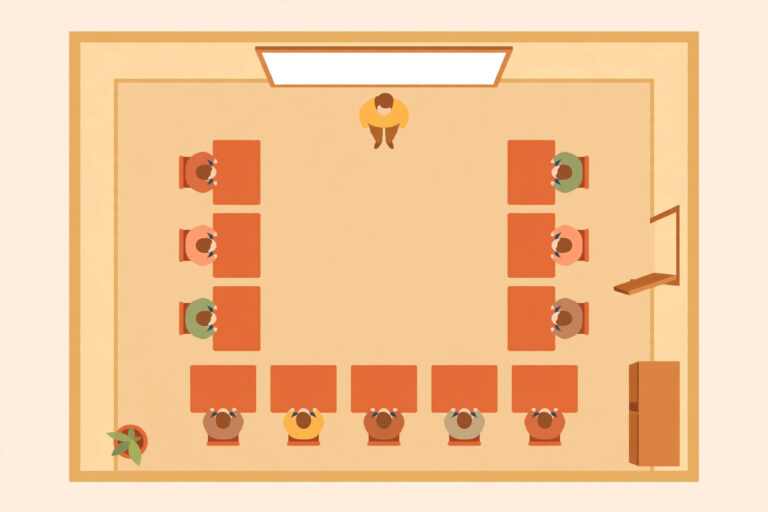
3. Change the room, even slightly
A new seating chart or desk arrangement signals that something has changed before you say a word. If you want ideas, see our guide to classroom seating arrangements or the 15 classroom layout ideas.
Week one: 6 steps to reset the class
4. Open with honesty, not a lecture
On the first day back, tell students what you noticed and what you want instead. Keep it short and own your part: “Before break, our starts were slow, and I let that slide. This semester we’re going to fix it together.” Students respond better to a clear plan than to a speech about disappointment.
5. Co-write or revisit the class norms
Ask students to rate each existing norm from 1 to 5 on how well the class followed it. Discuss the lowest two. If you never set norms, our guide to classroom norms walks through the process in one period.
6. Teach each routine like a lesson
Model the routine, have students practice it, and give feedback. Practicing the entry routine three times on Monday feels silly, but it saves minutes every day for the rest of the year. Time it, and let students try to beat their record.
7. Use a new attention signal
If your old signal stopped working, replace it. A call-and-response, a chime or a raised hand all work if you teach them and wait for full attention every time. Our list of classroom commands has short phrases that work well for this.
8. Start every class with a bell-ringer
A short task on the board that students begin without being told is the single most reliable fix for a chaotic start. Keep it to 3–5 minutes: one review question, a quick puzzle or a sentence to finish. Try a puzzle from our logic puzzles for teens on Fridays.
9. Re-set phone and device rules
Phones are the most common mid-year problem in secondary classrooms. Whatever your rule is, make it visible, make it the same every day, and give students one clear place to put devices. Consistency matters more than strictness.
Weeks two to four: 3 steps to make it stick
10. Catch students following the routines
Specific praise (“Table 3 was ready before the timer ended”) reinforces the routine you just taught. Aim for four positive comments for every correction during the first month.
11. Handle problems privately and quickly
Most behavior issues can be handled with a quiet word at the student’s desk, a reminder of the norm and a clear next step. Public corrections often turn a small issue into a power struggle. Our list of classroom management techniques covers low-key responses in more detail.
12. Review the reset after two weeks
Ask students for quick, anonymous feedback: what is working, what is still hard. Adjust one routine, keep the rest. A reset is not a one-day event; it becomes the way the class runs.
A sample first-day-back plan (50 minutes)
| Time | Activity |
|---|---|
| 0–5 min | Bell-ringer on the board: “One goal for this semester” |
| 5–12 min | Short talk: what you noticed, what will change |
| 12–25 min | Norms rating and discussion |
| 25–35 min | Teach and practice the entry and attention routines |
| 35–47 min | Light content review game (see review games for high school) |
| 47–50 min | Practice the end-of-class routine |
Common mistakes to avoid
- Changing everything at once. Students will follow two or three new routines; ten will collapse within a week.
- Making the reset feel like a punishment. Frame it as a fresh start, not a consequence.
- Dropping the routines after week one. Most resets fail in week three, when practice stops. Keep reminding and praising.
- Skipping the “why.” Teens follow routines they understand. Explain how each one saves them time or stress.
Frequently asked questions
When is the best time for a mid-year classroom management reset?
The first day back after winter break is the easiest time because students already expect change. A reset also works after any long break, after a difficult unit, or at the start of a new grading period.
How do I reset a class that has gotten out of control?
Start with the room and the routines, not consequences. Change the seating, teach one entry routine and one attention signal, and practice them daily for two weeks. Handle individual problems privately while the routines rebuild the overall tone.
Should I change my seating chart in January?
Usually yes. A new chart separates groups that formed unhelpful habits and signals a fresh start. Explain that it is part of the new semester, not a punishment.
How long does a classroom reset take to work?
Most teachers see a difference in the first week and a stable change after three to four weeks of consistent practice. The routines only stick if you keep reinforcing them after the first few days.
A mid-year reset is one of the most useful things you can do for the second half of the year. Pick three routines, teach them like content and keep practicing. For a complete system, read our classroom management guide and the classroom management plan template.