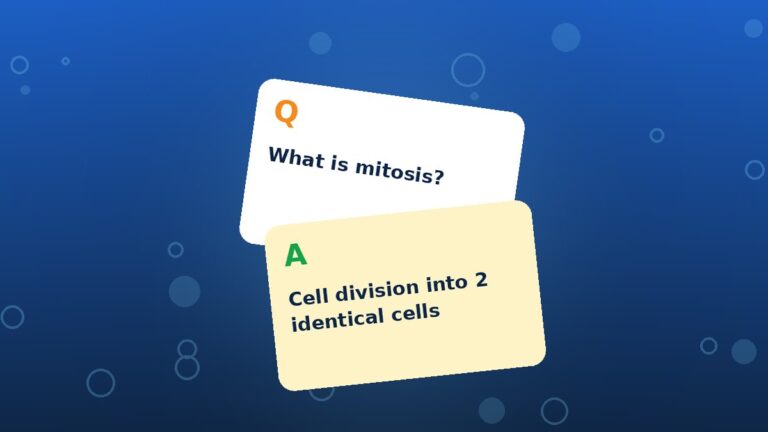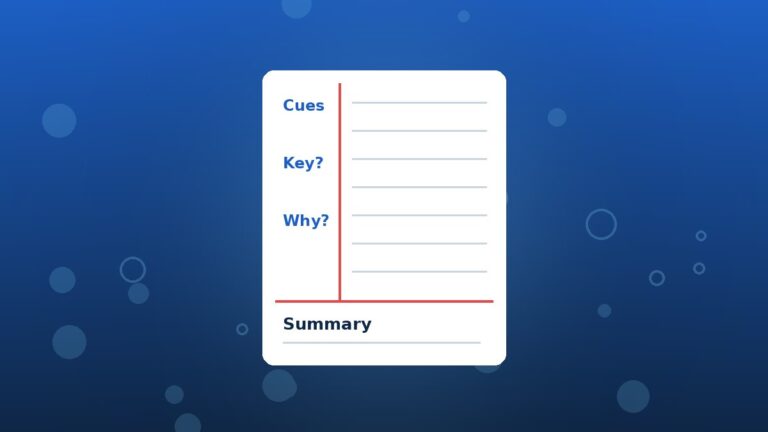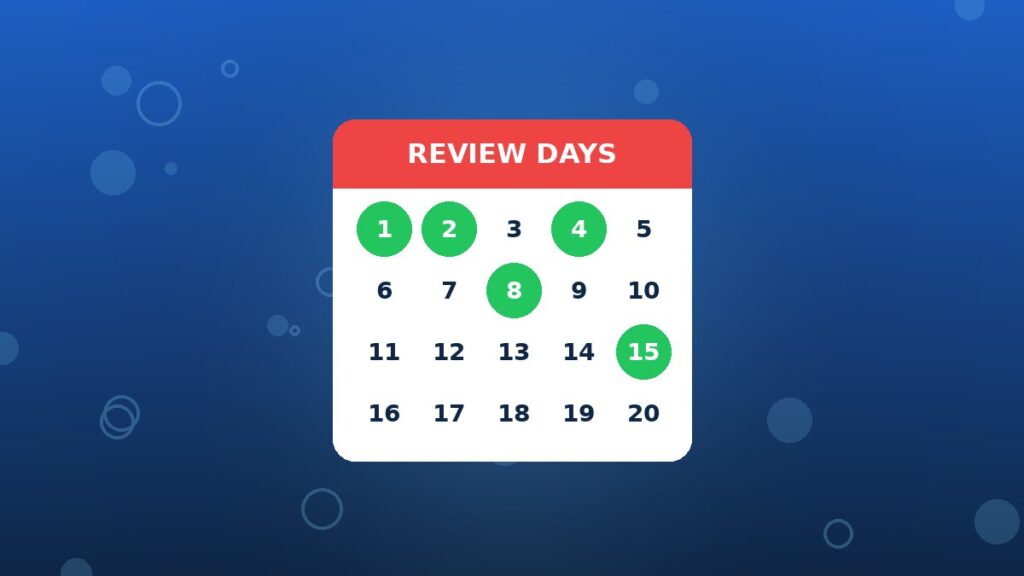
Spaced repetition means reviewing the same material several times, with growing gaps between reviews. Instead of studying a topic for three hours the night before a test, you study it for twenty minutes today, a few minutes tomorrow, again in three days and again in a week.
It takes about the same total time as cramming, but you remember far more weeks later. That matters in high school, where final exams cover months of lessons and every unit builds on the previous one.
In this guide8 sections
Why spacing beats cramming
In the 1880s, the German psychologist Hermann Ebbinghaus memorized lists of nonsense syllables and tested himself at different delays. He found that forgetting is fast at first and then slows down, a pattern now called the forgetting curve. He also found that each review made the memory fade more slowly than before.
Modern research agrees. A large review by Cepeda and colleagues in 2006 found that spreading study sessions apart produced better long-term memory than massing them together (Psychological Bulletin). A follow-up study in 2008 showed that the best gap grows as the test gets further away (Psychological Science). For a test in about a week, a review after a day or so works well. For knowledge you need in several months, gaps of a few weeks work better.
Cramming feels effective because the material is fresh during the session. But that freshness fades within days, which is why crammed facts are often gone by the final exam.
The 1-3-7 rule
You do not need software or a complicated formula. A simple rule works for most students:
- Day 0: learn the material in class or from your notes.
- Day 1: a short review the next day (5–10 minutes).
- Day 3: review again three days after you learned it.
- Day 7: review again one week after you learned it.
- After that: include it in a weekly mixed review until the exam.
Each review should be active: quiz yourself, explain it out loud or do practice problems. Rereading your notes does not count. Our guide to active recall has seven ways to test yourself.
A weekly schedule you can copy
Here is how the 1-3-7 rule looks across a school week. “L1” is Monday’s lesson, “L2” Tuesday’s and so on. Every day you add a short review block of 15–25 minutes:
| Day | New material | Review block |
|---|---|---|
| Monday | L1 | Last week’s lessons from 7 days ago |
| Tuesday | L2 | L1 (1 day) |
| Wednesday | L3 | L2 (1 day) |
| Thursday | L4 | L3 (1 day), L1 (3 days) |
| Friday | L5 | L4 (1 day), L2 (3 days) |
| Saturday | — | L5 (1 day), L3 (3 days) |
| Sunday | — | L4 (3 days) + 20-minute mixed quiz of the week |
| Next Monday | L6 | L5 (3 days), L1 (7 days) |
It looks like a lot written out, but each review is short because you are only checking what you remember. Fifteen focused minutes is enough. If you like timed blocks, one pomodoro per day covers it.
The three-box flashcard system
For facts and vocabulary, the Leitner system makes spacing automatic. It was popularized by the German science journalist Sebastian Leitner in the 1970s. You need flashcards and three boxes (envelopes or rubber bands work too).
| Box | When you review it | What goes in it |
|---|---|---|
| Box 1 | Every day | New cards and any card you got wrong |
| Box 2 | Every 3 days | Cards you answered correctly once |
| Box 3 | Every week | Cards you answered correctly twice in a row |
The rules are simple:
- A card you answer correctly moves up one box.
- A card you get wrong goes back to Box 1, no matter where it was.
- Say or write the answer before you flip the card.
The result: you spend most of your time on the cards you struggle with, and very little on cards you already know. Free flashcard apps such as Anki use the same idea with automatic scheduling, if you prefer studying on a device.
What to space (and what not to)
Spaced repetition works best for material you need to remember and use later:
- Vocabulary in English and foreign languages (our SAT & ACT Vocabulary quiz is good for a quick daily round)
- Formulas, definitions and key dates
- Math procedures, by redoing a few mixed problems from earlier units
- Science processes and diagrams
It is less useful for things you only need once, like a one-time reading for a discussion. It also does not replace understanding: if a concept makes no sense, review the lesson or ask for help first, then space your practice.
Common mistakes
- Reviewing by rereading. It feels productive but does little. Always test yourself.
- Skipping the review because “I still remember it.” That is the point: reviewing just before you forget is what makes the memory last.
- Making every gap the same. Reviewing every day forever wastes time. Let the gaps grow as you get things right.
- Starting the week before finals. Spaced repetition needs time to work. Start with the next lesson you have, not the next exam.
- Only reviewing new topics. Mix in older units. Mixed practice is harder, and that is exactly why it helps.
Make it a daily habit
The easiest way to stick with spacing is to attach it to something you already do: right after dinner, or on the bus. A short daily quiz helps too. Our Daily Brain Challenge gives you three new questions every day, and the quiz games are good for a five-minute review of facts.
Frequently asked questions
How long should each spaced review take?
Five to fifteen minutes per topic is usually enough. The goal is to check and strengthen what you remember, not to relearn the whole lesson.
Is spaced repetition better than cramming?
For anything you need to remember for more than a few days, yes. Cramming can work for a test the next morning, but most of the material is forgotten within days. Spaced study leads to much better long-term memory for the same total time.
Can teachers use spaced repetition in class?
Yes. Start lessons with three quick questions: one from yesterday, one from last week and one from last month. Low-stakes review games with mixed questions from older units work the same way.