AI chatbots can explain a hard concept five different ways, quiz you at midnight and never get impatient. They can also write an essay in ten seconds, which is exactly why so many schools are worried about them.
The difference between studying with AI and cheating with AI usually comes down to one question: who is doing the thinking? If the AI does the thinking and you hand in the result, you learn nothing and probably break the rules. If you do the thinking and the AI coaches, questions and checks you, it can be one of the best study tools you have.
In this guide7 sections
Rule one: check the policy for each class
Schools and teachers set very different rules. One teacher may encourage AI for brainstorming; another may ban it for a particular assignment. Before you use AI on schoolwork:
- Read your school’s academic integrity policy and the instructions for the assignment.
- If the rules are not clear, ask your teacher. “Can I use AI to quiz myself on this unit?” is a reasonable question.
- When you do use AI on graded work and it is allowed, say so (see the end of this article for an example).
Many AI services also set a minimum age and require parent permission for users under 18, so check the terms of any tool you use, or use the one your school provides.
Where the line usually is
| Usually fine for studying | Usually cheating on graded work |
|---|---|
| Asking for an explanation of a concept you don’t understand | Having AI write all or part of an essay you submit as your own |
| Asking AI to quiz you on your notes | Copying AI answers to homework questions |
| Generating extra practice problems | Using AI during a test or quiz |
| Asking for hints, not answers, when stuck | Paraphrasing AI text so it doesn’t look AI-written |
| Asking where your reasoning first goes wrong | Submitting AI-made sources, data or quotes without checking them |
| Planning a study schedule | Hiding AI use when a teacher asked you to disclose it |
The left column helps you learn. The right column replaces your learning, so you end up with a grade for work you can’t do yourself. That gap shows up in exams, in the next course and later in work.
8 honest ways to study with AI (with prompts)
1. Make it quiz you
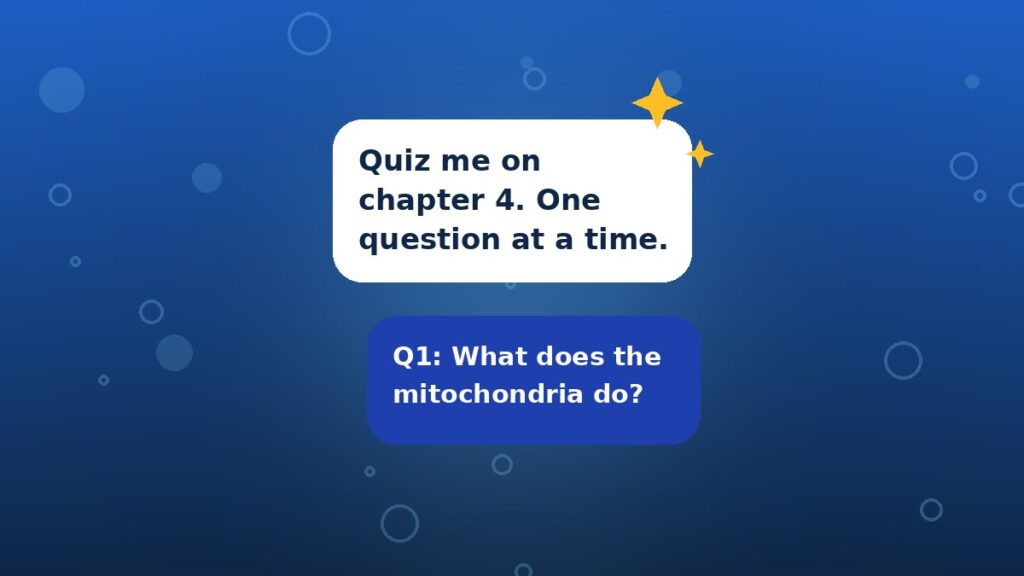
Testing yourself is one of the most effective ways to learn (see our guide to active recall). AI is a tireless quizmaster.
“I’m studying cell transport for a 10th-grade biology test. Ask me one question at a time. Wait for my answer, tell me if I’m right, and explain briefly if I’m wrong. Start easy and get harder.”
2. Get hints, not answers
“I’m stuck on this algebra problem: 3(x − 4) = 2x + 5. Don’t solve it. Give me one hint about the first step, then wait.”
This keeps the thinking in your head, where it needs to be for the test.
3. Ask for a different explanation
“Explain the difference between weather and climate as if I’m 15. Use one everyday example. Then ask me a question to check I understood.”
If the textbook explanation didn’t work, a second explanation often does. The follow-up question makes sure you understood it, not just read it.
4. Find the first mistake in your work
“Here is my solution to a physics problem. Don’t give me the right answer. Just tell me the first line where my reasoning goes wrong, and why.”
This turns AI into a coach that marks your work, rather than a machine that does it.
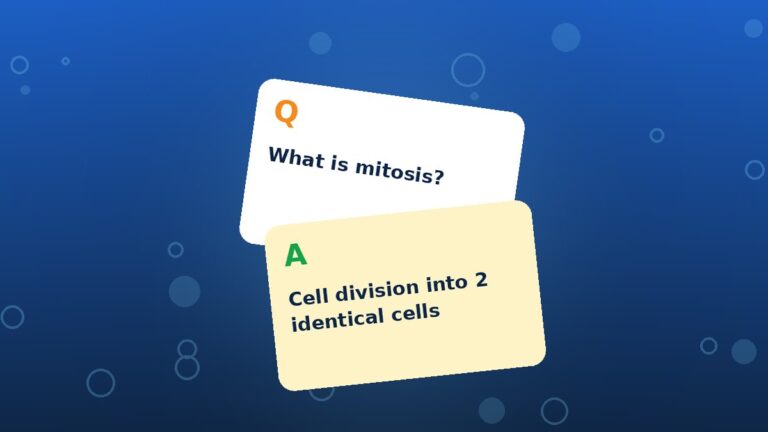
5. Turn your notes into flashcards
“Turn these notes into 15 question-and-answer flashcards. Make the questions require explanation, not just definitions.”
Then check every card against your notes before you study from it.
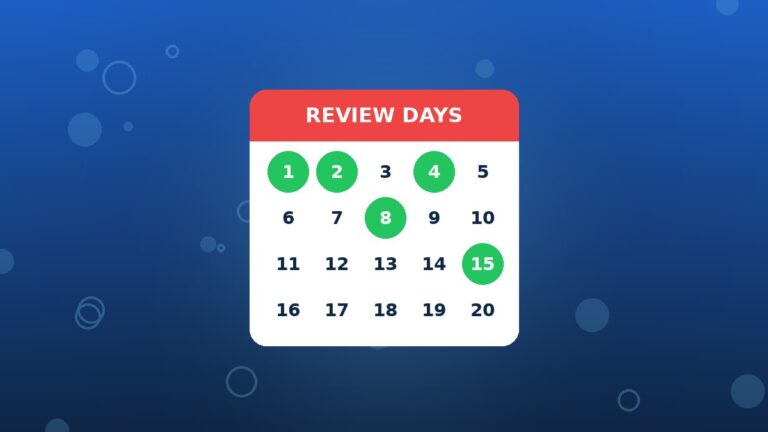
6. Plan your review
“My exams are on December 14 (math), 15 (history) and 17 (chemistry). My weakest topics are quadratics and the French Revolution. Make a 10-day study plan with 2 hours per day, using spaced review.”
Our 2-week finals plan and spaced repetition schedule explain the methods behind a good plan, so you can judge whether the AI’s plan makes sense.
7. Argue with it
“I think social media does more harm than good for teenagers. Argue the opposite side as strongly as you can, then let me respond.”
Practicing against counterarguments is great preparation for essays and debates. Just remember the essay itself must be your own.
8. Get feedback on clarity (only if allowed)
“Don’t rewrite this paragraph. Tell me which sentence is least clear and why.”
Asking for comments instead of a rewrite keeps the writing yours. Check your teacher’s rules first: some count any AI feedback on graded writing as outside help.
AI makes mistakes: always check
AI chatbots can state wrong facts with total confidence. They sometimes invent quotes, statistics and even sources that do not exist, and they can make arithmetic mistakes in long calculations. Protect yourself:
- Check facts against your textbook, class notes or a reliable source.
- Never cite a source you haven’t opened yourself. Search for it; if you can’t find it, it may not exist.
- Redo calculations yourself or with a calculator.
- Be suspicious of very confident answers to questions your teacher said were debated or uncertain.
Protect your privacy
- Don’t paste personal information: your full name, address, school login or photos of other people.
- Don’t upload other students’ work.
- Use the AI tool your school approves, if it has one; it may have stronger privacy protections.
How to disclose AI use
If your teacher allows AI and asks you to disclose it, a short note at the end of your work is usually enough:
“I used an AI chatbot to quiz me on the causes of World War I and to suggest which paragraph of my draft was least clear. All writing and analysis in this essay are my own.”
Being open about AI use builds trust and protects you if questions come up later.
Frequently asked questions
Is using AI for homework cheating?
It depends on how you use it and on your teacher’s rules. Using AI to explain concepts or quiz you is usually fine. Submitting AI-written answers or essays as your own work is usually cheating.
Can teachers tell if I used AI?
Sometimes, but that is the wrong question. The real risk is that you skip the learning, and that shows up in tests, class discussions and later courses where no AI is allowed.
What is the best way to use AI for studying?
Ask it to quiz you, give hints instead of answers, and find mistakes in your own work. For a quick daily warm-up without AI, try our Daily Brain Challenge: three questions a day, with explanations.