Finals cover months of material, often in several subjects in the same week. Cramming the night before does not work for that much content, and studying “a bit of everything” every day leaves you unsure what you actually know.
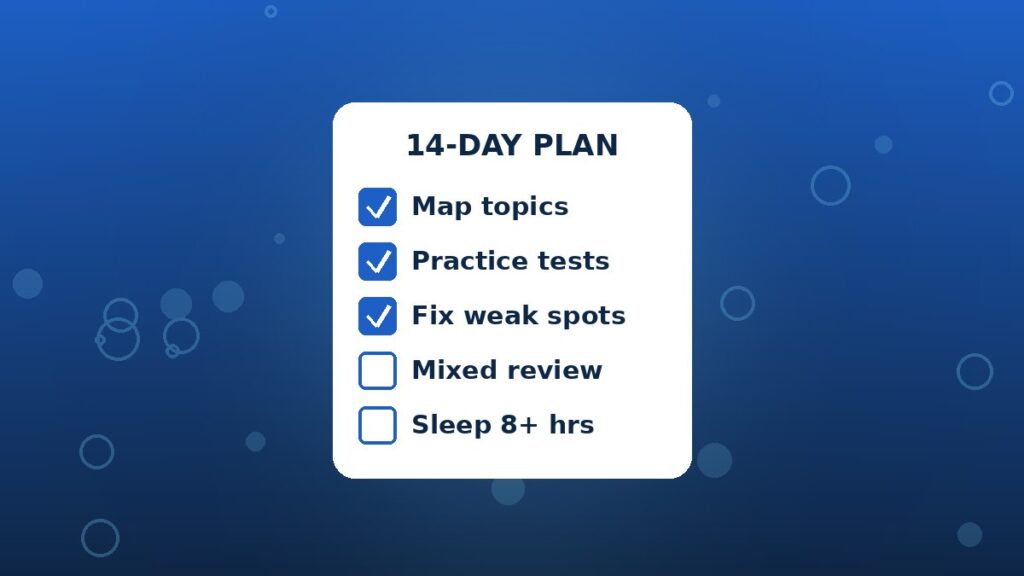
This plan gives you 14 days, step by step. It is built on two of the best-supported study methods: testing yourself (active recall) and spreading review over several days (spaced repetition). It assumes about two hours of study on school days and more on weekends.
In this guide9 sections
Step 1: Map every exam (Day 14)
Start with one honest hour of planning. For each subject, write down:
- the exam date and time
- the format (multiple choice, essays, problems, a practical)
- every unit or topic it covers (check the syllabus or ask your teacher)
Then rate each topic with a traffic light:
| Color | Meaning | What you will do |
|---|---|---|
| Green | I could explain this to someone now | Quick review and practice questions only |
| Yellow | I sort of know it, but would make mistakes | Self-test, then fix the gaps |
| Red | I don’t really understand it | Relearn first, with help if needed, then self-test |
Your red topics get the most time, and they go first, while you still have time to ask a teacher.
Step 2: Gather your materials (Day 14)
Collect notes, past quizzes and tests, homework with teacher corrections, review sheets and any practice exams. Your old mistakes are the most valuable study material you have: they show exactly where you lose points.
If your notes have gaps, borrow a classmate’s or ask your teacher for the slides now, not two days before the exam.
The 2-week plan, day by day
| Days | Focus | What to do |
|---|---|---|
| 14 | Plan | Map exams, rate topics, gather materials, make a schedule |
| 13–9 | Red and yellow topics | Relearn red topics, then self-test. Turn notes into questions. Ask your teacher about anything still unclear. |
| 8–5 | Practice under exam conditions | One timed practice test per subject. Mark it honestly and list every mistake. |
| 4–3 | Fix and mix | Redo every question you got wrong. Mixed quizzes across all topics, not one topic at a time. |
| 2 | Final review | Write a one-page summary of each subject from memory, then check it against your notes. |
| 1 | Light review and rest | 30–60 minutes of quick self-testing. Pack your bag. Go to bed on time. |
If finals are spread over a week, run this plan for your first exam and shift it for later ones. Subjects with later exams still get short review sessions every few days so they stay fresh.
A daily routine that fits around school
On a school day, two hours of focused work is enough if it is done well:
| Block | Time | What to do |
|---|---|---|
| 1 | 25 min | Hardest subject: self-test on a red or yellow topic |
| Break | 5 min | Away from your phone |
| 2 | 25 min | Same subject: fix the gaps you just found |
| Break | 5 min | Walk, water, snack |
| 3 | 25 min | Second subject: practice questions |
| Break | 5 min | Stretch |
| 4 | 25 min | Mixed quiz: 10 questions from older topics across subjects |
That is four pomodoros. Put a visible timer on your screen (our classroom timer works full-screen in any browser) and leave your phone in another room.
What to do in each study session
The rule: produce, don’t reread. Rereading notes feels productive, but testing yourself is what builds memory and shows you what you don’t know.
- Math and physics: do problems without looking at examples first. Redo old test questions you got wrong.
- Biology and chemistry: draw diagrams and processes from memory; quiz yourself on definitions and equations.
- History: write the causes, events and consequences of each topic from memory; put key events in order.
- English: practice timed essay outlines; recall key quotes and explain what each shows.
- Languages: translate into the language you are learning, not only out of it; practice speaking out loud.
Quick quizzes help with facts: our quiz games cover topics like the periodic table, world capitals and vocabulary.
Sleep is part of studying
During sleep, the brain strengthens and organizes what you learned during the day. The American Academy of Sleep Medicine recommends 8 to 10 hours of sleep per night for teenagers aged 13 to 18 (Journal of Clinical Sleep Medicine).
All-nighters trade the memory-building you need for a few extra hours of tired, inefficient studying. If you must choose between one more hour of review and an hour of sleep the night before an exam, choose sleep.
The night before and the morning of the exam
The night before:
- Do a short, calm self-test of the main ideas (30–60 minutes at most).
- Pack everything: pens, calculator with fresh batteries, ID, water.
- Put screens away an hour before bed.
The morning of:
- Eat breakfast, even something small.
- Look over your one-page summary once. Don’t try to learn anything new.
- Arrive early enough to find your seat calmly.
During the exam:
- Read every question first and start with the ones you are sure about.
- Watch the clock: divide your time by the marks each section is worth.
- If you blank on a question, move on and come back to it later. Your memory often recovers when the pressure drops.
Common mistakes to avoid
- Studying favorite subjects first. Start with red topics, while there is still time to get help.
- Making beautiful notes instead of testing yourself. Rewriting notes neatly feels useful but teaches little.
- Studying one subject per day. Shorter sessions across several subjects, revisited every few days, lead to better memory.
- Skipping breaks and sleep. Tired studying is slow studying.
- Ignoring old mistakes. Your corrected tests show exactly where points are lost.
If you take good notes during the rest of the year, finals get much easier. Our guide to Cornell notes, outlines and mind maps shows how to set them up so they become a ready-made self-test.
Frequently asked questions
How many hours a day should I study for finals?
Around two focused hours on school days and three to five hours on weekend days is plenty for most students, with breaks. Quality matters more than hours: self-testing for one hour beats rereading for three.
Is two weeks enough time to study for finals?
Yes, for most high school finals, if you start with a plan and focus on your weakest topics first. If you have many exams or a very weak subject, start that subject a week earlier.
What should I do if I have three exams in two days?
Put the exam dates on a calendar and work backward. Spend the days before on the subjects you are weakest in, and save quick reviews of your stronger subjects for the evening before each exam.