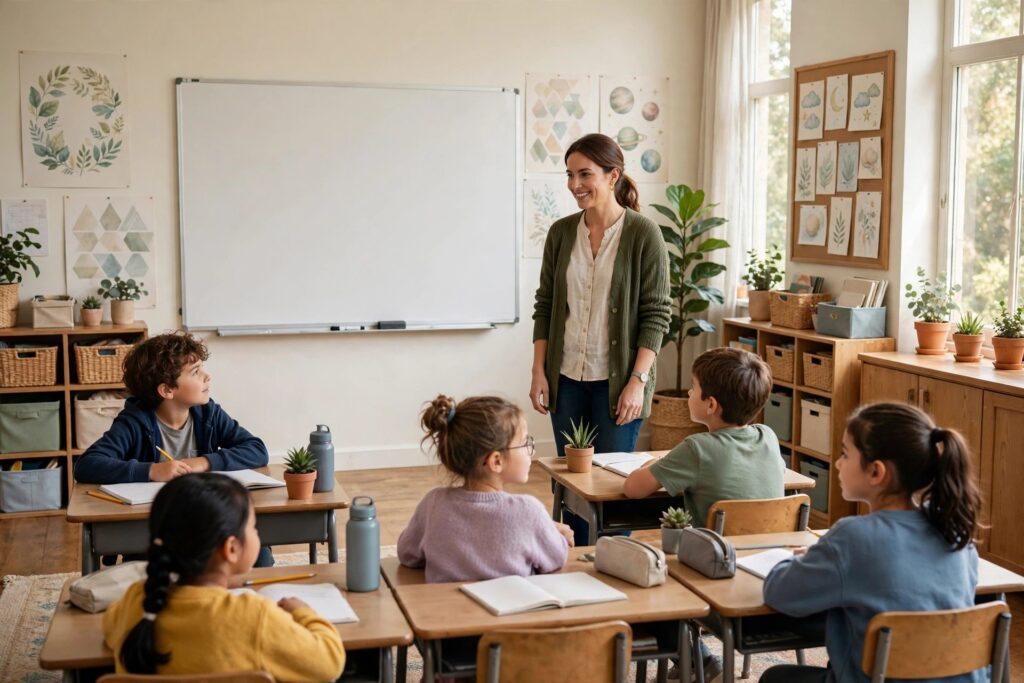
Most classroom management advice fails for one reason: it tells you what good classrooms look like but not how to build one. “Be consistent” is true and useless. This list is different — 25 specific, concrete strategies you can actually do, organized by when you use them: before problems start, during the daily flow, through engagement, and when disruption happens anyway.
This article is a companion to our Complete Guide to Classroom Management, which covers the five pillars underneath all of these strategies. If you are new to this, start there. If you want tactics for tomorrow morning, stay here.
In this guide6 sections
Prevention: Set the Stage Before Problems Start
Great management is 90% prevention. These strategies stop most behavior issues from ever forming.
1. Greet every student at the door
Stand at your door and greet students by name as they enter. It takes 60 seconds, and it does three things: it signals that class has started, it lets you read the room (who looks upset today?), and it tells each student they are seen. Teachers who do this consistently report fewer entry disruptions within two weeks.
2. Co-create norms with your students
Rules handed down feel like control; norms built together feel like ownership. Spend 20 minutes in week one having students propose, debate, and vote on 3–5 norms. Then post them and — this is the critical part — refer to them daily for the first month. The full process is in our classroom norms guide.
3. Over-plan the first two weeks
New teachers prepare lessons; veteran teachers prepare procedures. Script everything for the first two weeks: how students enter, where materials live, how they ask for help, how they leave. Boring? Yes. Effective? Enormously. Classes that invest in procedures in September run themselves by October.
4. Design the space for the behavior you want
Your room layout is a management strategy, not a decorating decision. Rows reduce peer distraction; clusters boost collaboration; a U-shape maximizes discussion. Match the arrangement to your most common activity, and put high-distraction students where your proximity is natural, not punitive. Compare options in our classroom layout ideas and seating arrangements guide.
5. Build a seating plan — then change it monthly
Random or fixed-forever seating both cause problems. Start with a deliberate plan (separate the sparks, place quiet students where they can hear), then rotate monthly. Rotations prevent territorial cliques and give you a legitimate reason to split up brewing conflicts without making it personal.
6. Start class the same way every day
A consistent opening ritual — a bell-ringer question on the board, a 2-minute journal prompt, a quick review game — kills the chaos of transitions. Students who know exactly what to do in the first three minutes give you those three minutes back, every single day. That is roughly 9 hours of instructional time per year.
7. Teach transitions like lessons
“Line up quietly” is a wish, not a procedure. Break every transition into steps, model them, practice them, and time them. Make it a game: “Can we beat yesterday’s 47 seconds?” Classes that practice transitions explicitly cut lost time dramatically — and the gamification makes students want to be fast.
Routines & Procedures That Run the Room
Procedures are the invisible machinery of a well-managed classroom. These are the ones with the highest return.
8. Use a single attention signal — and never talk over noise
Pick one signal (hand raised, chime, call-and-response) and use it only for attention. The golden rule: never start talking until you have 100% of eyes. The first week this feels slow. By week three, your signal works in seconds — because students learned that you mean it.
9. Give crisp, one-step directions
“Take out your notebooks, turn to page 47, read the first paragraph silently, and then answer question 3 in full sentences” is four directions, which means zero were heard. Give one step, wait for compliance, then give the next. Pair it with a visual (write the step on the board) for students who process better by reading. Our classroom commands list has 50 pre-written phrases for exactly this.
10. Make the timer visible
“Five more minutes” means nothing; a countdown on the screen means everything. A visible classroom timer removes you from the role of time-police and makes pacing the class’s shared responsibility. Use it for warm-ups, group work, clean-up, and tests.
11. Standardize how students ask for help
Unstructured help-seeking (“Teacher! Teacher! Teacher!”) derails everyone. Teach a system: colored cups on desks (green = fine, yellow = question, red = stuck), a help board where students write their names, or a “ask three before me” rule. Any system beats no system.
12. Build a “what to do when done” menu
Fast finishers with nothing to do become management problems in about 90 seconds. Keep a posted menu: extension task, reading corner, peer tutoring, a classroom game from the site’s collection. The menu must be self-directed — if it requires your input, it is not a solution.
13. End class with an exit routine, not a bell scramble
The last five minutes shape tomorrow’s first five. Use a quick exit ticket (one thing learned, one question remaining), a 2-minute tidy-up with music, and a calm dismissal by rows or groups — never a mass exodus at the bell. You will be amazed how much calmer tomorrow starts.
Engagement: The Best Behavior Strategy Is a Good Lesson
Bored students misbehave. Engaged students do not have time to. These strategies attack behavior problems at their most common root.
14. Build movement into every lesson
Adolescent brains (and honestly, adult ones) cannot sit still for 50 minutes. Add a stand-and-pair discussion, a gallery walk of posted work, or a stretch break between activities. Even 60 seconds of movement resets attention — and prevents the fidgeting that escalates into disruption.
15. Cold-call with care, not fear
Random calling keeps everyone alert, but only if it feels safe. Use “no-opt-out” framing: if a student does not know, you stay with them, give a hint, and let them succeed — never move on to embarrass them. Pair it with think-pair-share first so nobody is ever truly cold. Participation rises; anxiety does not.
16. Gamify the boring parts
Review days, vocabulary drills, and practice sets are engagement deserts — which is exactly where behavior problems bloom. Turn them into games: points, teams, timers, small stakes. Our collection of 101 free classroom games is built for exactly this, and most need zero preparation.
17. Give students real choices
Autonomy is a powerful engagement lever. “Do problems 1–10” invites groans; “choose any 7 of these 10, and do the challenge problem for bonus” invites buy-in. Choice boards, topic selection for projects, and even seating choice (earned, not automatic) all reduce the power struggles that look like behavior problems.
18. Use the 10:2 rule
For every 10 minutes of teacher talk, give students 2 minutes to process — turn and talk, write a summary sentence, sketch the concept. This is not just good pedagogy; it is management. Processing breaks prevent the glazed-eye restlessness that turns into side conversations and, eventually, real disruption.
Responding to Disruption Without Losing the Room
Even perfect prevention leaves the 10%. These strategies handle disruption while protecting the learning of the other 29 students.
19. Use the least invasive intervention first
Think of a ladder: proximity (walk near) → nonverbal cue (eye contact, hand on desk) → quiet redirect (“I need you tracking me”) → private conversation → consequence. Most issues die at rung one or two. Skipping straight to public confrontation escalates what proximity would have solved — and costs you the room’s sympathy.
20. Correct privately, praise publicly
Never correct a student in front of peers if you can avoid it. A quiet word during independent work preserves dignity and actually changes behavior; a public callout buys compliance at the cost of resentment. Flip it for praise: specific, public recognition (“Maya’s transition was silent in 30 seconds — that’s the standard”) teaches the whole class what success looks like.
21. Name the behavior, not the student
“Talking during instruction stops now” addresses the behavior. “You always talk during instruction” attacks the student — and invites a defensive argument you cannot win in front of an audience. Keep language behavioral, brief, and forward-looking: what to do now, not what they did wrong.
22. Give a reset, not a lecture
When a student is dysregulated, logic is offline. Offer a structured reset: two minutes at the calm-down corner, a drink of water, a brief walk with a pass. Frame it as a tool, not a punishment: “Take two minutes and come back ready.” You will get a functional student back; a lecture would have gotten you an argument.
23. Follow up after every consequence
A consequence without a follow-up conversation teaches only that you are powerful. The next day, have a 60-second private check-in: what happened, what you need from them, and — critically — that you are glad they are here. This repair step is what turns discipline into a relationship instead of a grudge.
24. Document patterns, not incidents
One disruption is an incident; five is a pattern with a cause. Keep a simple log (date, time, what happened, what preceded it). Patterns reveal triggers — always during transitions? Always after lunch? Always in one seating arrangement? — and triggers are fixable in a way that “bad behavior” is not.
25. Protect your own calm first
The most underrated management strategy is teacher self-regulation. A calm teacher de-escalates; a reactive teacher multiplies. Build your own reset habits: pause before responding, keep water at your desk, debrief with a colleague instead of ruminating. Your nervous system sets the ceiling for the room’s.
Classroom Management Strategies FAQ
Which classroom management strategy works fastest?
The attention signal (#8) plus greeting at the door (#1) — both show results within two weeks because they change the highest-frequency moments of the day: entry and transitions.
What is the best strategy for a difficult class mid-year?
Reset with a co-created norms session (#2) and explicit transition practice (#7). Mid-year resets work — frame it as “we’re leveling up,” not “you’ve been bad.” Add a seating rotation (#5) to break up established dynamics.
Do these strategies work for online or hybrid classes?
Most translate directly. Attention signals become chat-box cues or reaction emojis, timers stay on screen share, exit tickets become a 2-question form, and breakout rooms replace physical movement. The principles — prevention, clear procedures, engagement — are identical.
How many strategies should I try at once?
One or two. Pick the strategy that addresses your biggest daily pain point, practice it for two weeks until it is automatic, then add the next. Trying all 25 at once is how strategies die.
What if nothing seems to work with one student?
Go to strategy #24: document the pattern and look for the trigger. If the pattern suggests needs beyond your classroom (trauma, undiagnosed learning needs, home instability), loop in your counselor or support team early. Some problems are bigger than strategies — and recognizing that is itself good management.
The Bottom Line
You do not need all 25 strategies. You need the three or four that fix your room’s specific leaks — and the discipline to practice them until they are habits, not experiments. Start with prevention, build your procedures, engage relentlessly, and respond to the rest with calm consistency.
For the theory behind these tactics — the five pillars, management styles, and the mistakes to avoid — read the Complete Guide to Classroom Management. Then pick one strategy from this list and use it tomorrow. That is how good classrooms get built: one deliberate habit at a time.