Knowing how to study for a math test is different from studying for history or English. Rereading notes feels productive, but math is a skill you show by solving problems, so the only reliable preparation is doing problems, checking them and fixing what went wrong. Teachers can share this guide with students or use it as a mini-lesson before a unit test.
Below you will find the core principles, a five-day study plan, an error log method and tips for test day. The plan works for algebra, geometry, precalculus and most other high school math courses.
In this guide8 sections
Core principles
Practice, don’t reread
Watching a worked example and thinking “I get it” is not the same as solving a problem from a blank page. Research on learning consistently supports retrieval practice, meaning recalling information without looking. Our guide to the active recall study method explains why it works.
Mix problem types
On a test, problems are not labeled by section. Practicing a shuffled set teaches students to recognize which method a problem needs, not just how to execute a method they were told to use.
Spread it out
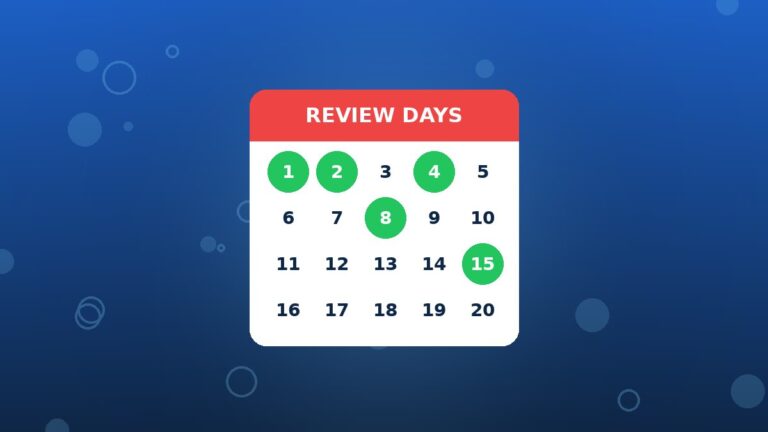
Several short sessions over a few days beat one long session the night before. A spaced repetition schedule keeps earlier topics fresh.
The 5-day study plan
Day 1: Map the test
List every problem type that could appear, using the unit outline, homework and any review sheet. Next to each, rate your confidence from 1 to 3. This becomes your study map.
Day 2: Attack the weakest types
Pick your two or three lowest-rated problem types. Rework examples from class with the solution covered, then try three to five similar problems. Check every answer.
Day 3: Build an error log
Go back through old homework and quizzes. For each mistake, write the problem, what went wrong and the corrected step. Label each error: concept, procedure or careless.
Day 4: Take a practice test
Create a mixed set of 10 to 15 problems, or use a review sheet, and do it under timed conditions without notes. Grade it honestly and add any new mistakes to your error log.
Day 5: Light review and rest
Reread your error log, redo a handful of problems you previously missed and review formulas. Then stop at a reasonable hour; sleep supports memory more than a late-night cram.
Turning mistakes into points
| Error type | Example | How to fix it |
|---|---|---|
| Concept | Not knowing when to use the quadratic formula | Reread notes, ask the teacher, do 3 problems of that type |
| Procedure | Forgetting to flip the inequality when dividing by a negative | Write the rule on a checklist, practice 5 problems |
| Careless | Sign errors, copying the problem wrong | Slow down on the first line, check by substitution |
| Time | Running out of time on the last section | Timed practice, skip and return strategy |
Study methods that work for math
- Blank-page practice: copy problems onto a clean sheet so you cannot peek at your old work.
- Explain it aloud: talk through each step as if teaching a friend. Gaps in reasoning become obvious.
- Make a one-page summary: formulas, key steps and a worked example per problem type. See how to make a study guide for formats.
- Use focused sessions: 25 minutes of problems, 5 minutes off, using the Pomodoro technique.
- Study with a partner: quiz each other with problems from the error log.
Test-day tips
- Write down key formulas as soon as you are allowed to.
- Skim the whole test and start with problems you are confident about.
- Show every step; partial credit often depends on it.
- If stuck for more than two minutes, mark the problem and move on.
- Save time at the end to check answers, especially signs and units.
For teachers: making this a class routine
Hand out a blank problem-type map at the start of a unit and have students rate their confidence after each lesson. Before the test, run a math review game using the problem types students rated lowest. After the test, give class time to complete error logs so corrections become learning rather than a grade check.
Frequently asked questions
How long should I study for a math test?
Most students do well with 30 to 45 minutes of focused practice per day for four or five days. Quality matters more than total hours.
Is it okay to study the night before a math test?
A short review the night before is helpful, but learning new material for hours that night usually backfires. Use it to review your error log and get enough sleep.
What if I don’t understand the material at all?
Start early and ask for help: your teacher, a tutor or a classmate. Bring specific problems and say exactly where you get stuck.
How do I stop making careless mistakes?
Track them in an error log, slow down on the first steps of each problem and check answers by plugging them back in when possible.
Final thoughts
The best way to study for a math test is to practice like the test: mixed problems, no notes and honest checking. Follow the five-day plan, keep an error log and treat every mistake as information, and math tests become far less stressful. For more support, explore our tips on time management for students.