Classroom management is the set of strategies, routines, and relationships that keep a classroom running smoothly so learning can actually happen. It is not about being strict, and it is definitely not about punishment. Done well, classroom management is nearly invisible: students know what to do, transitions are quick, and you spend your energy teaching instead of redirecting.
If you have ever ended a school day exhausted from repeating yourself, you already know why this matters. Research consistently shows that teachers cite classroom management as one of the biggest factors in both student achievement and their own job satisfaction. The good news? It is a skill, not a personality trait. And skills can be learned.
This guide covers everything: the five pillars of effective classroom management, proven strategies you can use tomorrow, mistakes to avoid, and free tools that make the whole thing easier. Whether you are a first-year teacher or a veteran looking to reset, start here.
In this guide9 sections
- What Is Classroom Management, Really?
- Why Classroom Management Matters More Than Ever
- The 5 Pillars of Effective Classroom Management
- 15 Classroom Management Strategies That Work
- Classroom Management for New Teachers
- 7 Common Classroom Management Mistakes to Avoid
- Free Tools That Make Classroom Management Easier
- Classroom Management FAQ
- The Bottom Line
What Is Classroom Management, Really?
At its core, classroom management is everything you do to create an environment where students can learn. That includes how you arrange desks, how you start class, how you give directions, how you handle disruptions, and how you build trust with thirty different personalities at once.
A common misconception is that classroom management equals discipline. Discipline is only one small piece, and it is the piece you need least when the rest of the system works. Think of it this way: great classroom management is 90% prevention and 10% response.
Why Classroom Management Matters More Than Ever
Today’s classrooms are more complex than they were a decade ago. Larger class sizes, wider gaps in student readiness, shorter attention spans shaped by constant digital stimulation, and the lingering effects of disrupted schooling have all raised the bar. Teachers are being asked to differentiate instruction, support mental health, integrate technology, and somehow still cover the curriculum.
None of that is possible in a chaotic room. Studies estimate that teachers can lose up to 30% of instructional time to non-instructional issues like transitions, repeated directions, and behavior redirection. Over a school year, that is months of lost learning. Strong classroom management does not just make your day calmer; it literally gives your students more education.
The 5 Pillars of Effective Classroom Management
Every well-managed classroom rests on the same five foundations. Get these right and most “behavior problems” solve themselves before they start.
1. Clear Expectations and Norms
Students cannot meet expectations they do not understand. The most effective teachers do not just post rules on the wall in September; they teach behavior the way they teach content: explicitly, with modeling, practice, and feedback.
Instead of vague rules like “be respectful,” translate expectations into observable actions: “When someone is speaking, eyes on them and voices off.” Better yet, build the norms with your students. Ownership creates buy-in, and buy-in creates compliance without constant enforcement.
For a ready-to-use list, see our 30 classroom norms examples and how to set them — including how to run the norm-setting discussion in a single class period.
2. Consistent Routines and Commands
Routines are the autopilot of a well-managed classroom. Entry routine, attention signal, transition procedure, dismissal routine: when students know exactly what happens next, you stop spending willpower on logistics.
The key is teaching routines explicitly in the first weeks, then reinforcing them until they are automatic. Use short, consistent verbal commands so students always know what a direction sounds like. A calm “Eyes on me in 3… 2… 1” beats a shouted “Hey! Listen!” every single time.
We have compiled 50 essential classroom commands organized by situation — attention getters, transitions, group work, and dismissal — so you never have to improvise.
3. A Physical Space That Supports Learning
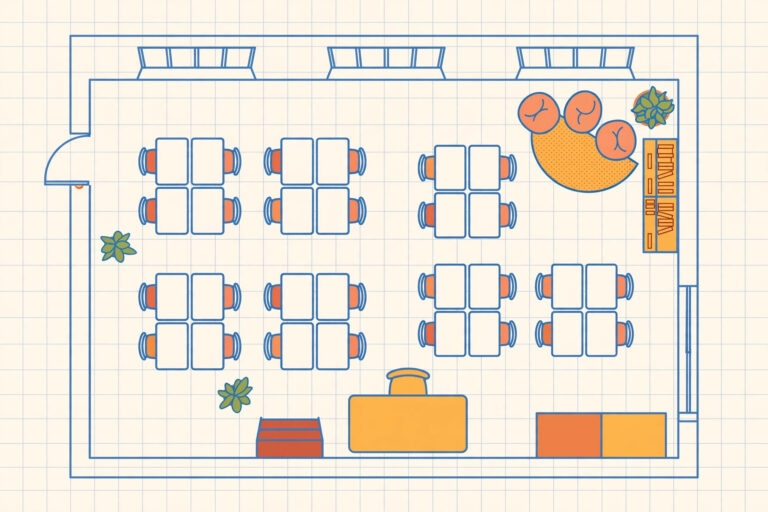
Your room layout is a management tool. Rows minimize talking but kill collaboration. Pods invite discussion but also distraction. There is no single best arrangement, only the best arrangement for what you are doing that day.
Design your space around traffic flow (can students move without bumping into each other?), sight lines (can you see every face from where you usually stand?), and flexibility (can you rearrange in under two minutes?). Even small tweaks, like angling desks slightly toward the board, reduce off-task behavior.
Explore 12 classroom seating arrangements that work, floor plan ideas with free templates, and 15 layout ideas for every grade level to find setups that match your teaching style.
4. Engagement Over Enforcement
Here is the open secret of classroom management: bored students misbehave, engaged students do not. The most powerful behavior strategy is a lesson students do not want to miss. Pace, variety, movement, choice, and challenge are management tools disguised as pedagogy.
This does not mean every lesson must be entertainment. It means building in regular brain breaks, mixing direct instruction with active tasks, and giving students some agency over how they learn. A five-minute game between heavy content blocks can buy you thirty minutes of focused work.
Keep a bank of no-prep options handy: our 109 free classroom games and brain break games for high school are sorted by category so you can grab one in seconds.
5. Calm, Consistent Consequences
When prevention fails — and sometimes it will — consequences should be calm, consistent, and connected to the behavior. The goal is never to win a power struggle; it is to teach the student a better choice for next time.
Consistency matters more than severity. A mild consequence applied every time changes behavior faster than a harsh one applied randomly. And private corrections preserve dignity: most students will cooperate with a teacher who corrects them quietly far more readily than one who calls them out in front of peers.
15 Classroom Management Strategies That Work
Beyond the pillars, these are concrete strategies working teachers use every day:
- Greet students at the door. Thirty seconds of personal connection per student sets a positive tone and lets you spot problems before they enter the room.
- Start class with a bell ringer. A short task on the board the moment students sit down eliminates the chaotic first five minutes.
- Use an attention signal and stick to one. Whether it is a clap pattern, a chime, or “class-class / yes-yes,” consistency is what makes it work.
- Give directions in chunks. One step at a time, then check for understanding before releasing students to work.
- Move around the room. Proximity is the simplest behavior tool there is. Most off-task behavior stops when the teacher is nearby.
- Narrate the positive. “I see Maya already has her notebook open” redirects the whole class without a single correction.
- Build in movement. Stand-up discussions, gallery walks, and stretch breaks discharge the restlessness that fuels disruption.
- Offer structured choices. “You can start with the odd or even problems” gives autonomy without giving up control.
- Keep transitions under two minutes. Time them, practice them, and celebrate when the class beats its record.
- Use nonverbal redirects first. Eye contact, a hand signal, or a sticky note on a desk corrects behavior without interrupting the lesson.
- End class with an exit ticket. A two-minute check for understanding doubles as a calm, structured dismissal.
- Follow up privately. A two-minute hallway conversation after class resolves more than a public confrontation ever will.
- Track patterns, not just incidents. If the same student struggles every day at 2 PM, the problem might be the schedule, not the student.
- Repair relationships quickly. After a conflict, a brief genuine check-in (“We’re good? I want us to have a good day tomorrow”) prevents grudges.
- Reflect weekly. Five minutes on Friday asking “What worked? What will I change?” compounds into mastery over a career.
Classroom Management for New Teachers
If this is your first year, everything above still applies, but prioritize ruthlessly. You cannot build Rome in September. Focus on three things in your first month:
- Routines first, content second. Spend the first two weeks over-teaching procedures. It feels slow. It pays off all year.
- Be warm and firm. The old advice “don’t smile until December” is outdated, but the kernel of truth remains: it is easier to relax later than to tighten up later. Set the bar clearly, then be the kindest person holding it.
- Steal shamelessly. Observe experienced teachers, borrow their attention signals, copy their seating charts. Classroom management is a craft tradition; apprenticeship is how it is learned.
And give yourself grace. Every veteran teacher you admire survived a rough first year. The fact that you are reading a guide like this already puts you ahead.
7 Common Classroom Management Mistakes to Avoid
- Assuming students know the routine. “You should know this by now” is a sign the routine was never taught explicitly enough.
- Escalating to match the student. When voices rise, the adult’s job is to be the thermostat, not the thermometer.
- Inconsistent enforcement. Letting something slide on Monday and punishing it on Friday teaches students that rules are random.
- Over-relying on whole-class punishment. Punishing everyone for one student’s behavior breeds resentment toward you, not the misbehaving student.
- Talking over noise. Every time you raise your voice to compete with chatter, you teach the class that louder wins. Wait for quiet instead.
- Neglecting the physical environment. A cluttered, confusing room creates cluttered, confused behavior.
- Taking it personally. A student’s outburst is data about their day, not a verdict on your teaching. Respond to the need, not the insult.
Free Tools That Make Classroom Management Easier
Good systems beat good intentions. These free tools handle the logistics so you can focus on students:
- Classroom Timer — a big, visual fullscreen timer for transitions, timed tasks, and tests. Project it and stop saying “two more minutes” on repeat.
- 109 Free Classroom Games — searchable by category (memory, quiz, math, words, reaction, strategy, logic). Perfect for brain breaks and review days.
- 10 PhET Classroom Simulations — interactive science and math simulations that run in the browser. Engagement is the best management strategy there is.
- 101 Free Classroom Games for Teachers (Roundup) — the full annotated list if you want to browse by teaching goal.
Classroom Management FAQ
What is the most effective classroom management style?
Research points to the authoritative style: high warmth combined with high expectations and clear boundaries. It outperforms authoritarian (high control, low warmth) and permissive (high warmth, low control) approaches on both behavior and achievement measures.
How do you handle a disruptive student without disrupting the class?
Use the least invasive intervention first: proximity, eye contact, or a quiet nonverbal cue. If that fails, a brief private word — during independent work, not in front of everyone. Save longer conversations for after class, and always follow up to repair the relationship.
What should classroom rules look like?
Keep them few (3–5), positive (“We raise hands” beats “Don’t shout out”), and observable. Post them, teach them like content, and revisit them after breaks. Even better, create them with your students — see our classroom norms guide for the full process.
How long does it take to establish good classroom management?
Expect to invest heavily in the first 4–6 weeks of the school year. Most teachers report that routines feel automatic around October if taught explicitly from day one. Mid-year resets work too — it is never too late to reteach a routine.
Does seating arrangement really affect behavior?
Yes, measurably. Studies show seating affects on-task behavior, participation rates, and even the frequency of peer conflicts. The effect is strongest when the arrangement matches the activity — which is why flexible setups outperform fixed ones. Compare options in our seating arrangements guide.
What is the single best classroom management tip for beginners?
Over-plan your procedures, not just your lessons. New teachers usually prepare content thoroughly but wing the logistics — entry, materials, transitions, dismissal. Script those first, and the content will have room to breathe.
The Bottom Line
Classroom management is not a talent you are born with or a script you memorize. It is a set of learnable practices: clear norms, tight routines, a thoughtful space, genuine engagement, and calm consistency when things go sideways. Start with one pillar, master it, and add the next.
Your classroom will never be perfect — and it does not need to be. It needs to be good enough that learning happens most of the time, and recoverable when it doesn’t. That is an achievable standard, and this guide just gave you the map.
Ready for the next step? Dive deeper into setting classroom norms, upgrade your classroom commands, or redesign your space with our layout ideas.